Wondering About Lens Insertion Surgery Recovery and Vision Stabilization?



Hello.
I'm Kim Joong-hoon, head director of Gangnam ID Eye Clinic.
I'd like to greet you.
Vision is directly connected to all aspects of life. How you correct your vision is a very important issue. Recently, there has been an increasing demand for vision correction surgery as treatment options for correcting vision, which has deteriorated due to refractive errors, have become more diverse.
Many people compensate for their vision with glasses or contact lenses, but they often consider and then give up on vision correction surgery due to the various inconveniences that arise with each changing season.
Vision correction surgery clearly resolves problems caused by assistive devices without the need for glasses or contact lenses, and has now become a familiar choice for many.
However, before vision correction surgery, it is important to choose a method suitable for your individual eyes through a thorough examination. If laser vision correction surgery such as LASIK or LASEK is difficult due to safety concerns, it is necessary to be aware that the methods you can proceed with may be different.
In particular, lens insertion surgery can be considered for eyes that require a large amount of corneal ablation, such as in cases of high myopia, high astigmatism, or extreme myopia. Today, I'm going to comprehensively discuss the basic principles and procedures of lens insertion surgery, the lens insertion surgery recovery period, and the insertion location.
"What if LASIK and LASEK have shortcomings?"
LASIK and LASEK are commonly thought of when it comes to vision correction surgery. Both methods use a laser to cut the cornea, thereby adjusting the refractive power.
However, if you have extreme myopia/astigmatism of -9 diopters or higher, excessively thin corneas, or poor corneal shape, it may be difficult to perform general laser vision correction surgery that cuts the necessary amount of cornea using a laser.
Since it is a method of cutting the cornea, the corneal thickness must be sufficient to proceed without difficulty. If vision correction surgery is performed forcibly in this state, various side effects such as dry eye, light scattering, corneal opacity, myopia regression, and keratoconus may occur, requiring a more cautious approach.
Since both methods can only be performed if certain criteria are met, it is good to be aware in advance that they are not applicable to everyone. In these cases, lens insertion surgery can be considered.
"Understanding the Basic Principles and Characteristics of Lens Insertion Surgery"
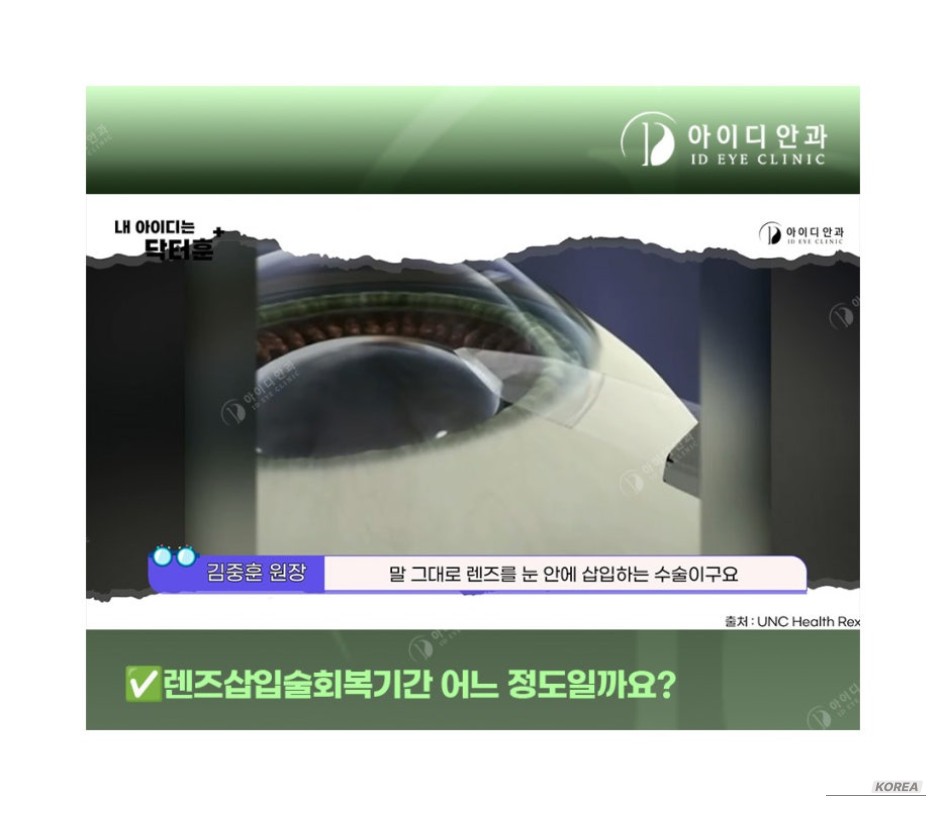
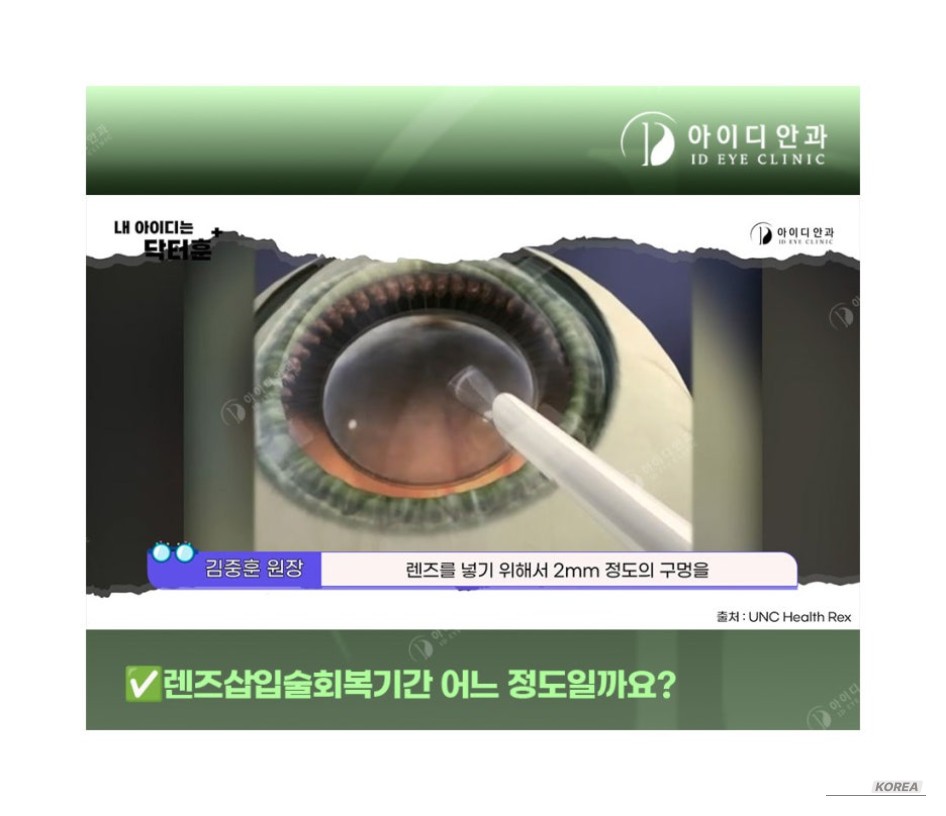
Lens insertion surgery involves creating a small incision of about 2-3mm in the cornea and inserting a biocompatible special lens into the eye without cutting the cornea to correct myopia and astigmatism.
Since the cornea is not cut, it has the advantage of being widely applicable even in cases of thin corneas or extreme myopia and astigmatism. It is also known to have a low risk of side effects due to corneal damage, and is stable and has excellent visual function.
In addition, lens insertion surgery can be applied even in cases where myopia has recurred after laser vision correction surgery. It also has the advantage of being less painful and having a shorter recovery period.
The risk of side effects such as dry eye, light scattering, and myopia regression is also low. Occasionally, if side effects occur due to the lens, the inserted lens can be removed to return to the previous state, making it semi-permanent and excellent in terms of safety.
"What is the lens insertion surgery recovery period like?"
Regarding the lens insertion surgery recovery period, it is generally less burdensome for busy office workers or students because it is less painful and has a shorter recovery period.
Generally, if you take a rest for a few days after the correction, you can quickly return to your daily life without much inconvenience.
However, lens insertion surgery also requires continuous follow-up care, so it is best to avoid actions such as rubbing your eyes and be careful when washing your face to prevent water from entering your eyes.
In addition, if you have eye drops prescribed by an ophthalmologist, it is one of the necessary steps to instill them on time and receive regular eye exams every 6 months.
"What are the differences depending on the location where the lens is inserted?"
Lens insertion surgery is divided into anterior lens and posterior lens depending on the location where the lens is inserted.
In the past, anterior lens insertion, which involves inserting the lens in front of the iris, was mainly performed, but recently, posterior lens insertion, which has improved safety, has been mostly applied.
Anterior lenses correct vision by placing the lens in front of the iris. Although there is less risk of the lens rotating in the eye, caution is required because it is close to the corneal endothelial cells.
Posterior lenses have a small hole in the center of the lens, allowing aqueous humor to flow smoothly through this hole, eliminating the need for iridotomy. The lens is placed stably between the iris and the crystalline lens.
Since most of the cornea is preserved, it can prevent dry eye that can occur due to corneal damage. It also has the characteristics of being able to see all distances clearly and allowing same-day bilateral procedures, resulting in high satisfaction.
As such, anterior and posterior lens insertion surgery each have their own advantages and disadvantages, but personally, posterior lens insertion surgery is preferred because the lens in anterior lens insertion surgery can become too close to the corneal endothelial cells, which can compromise safety.
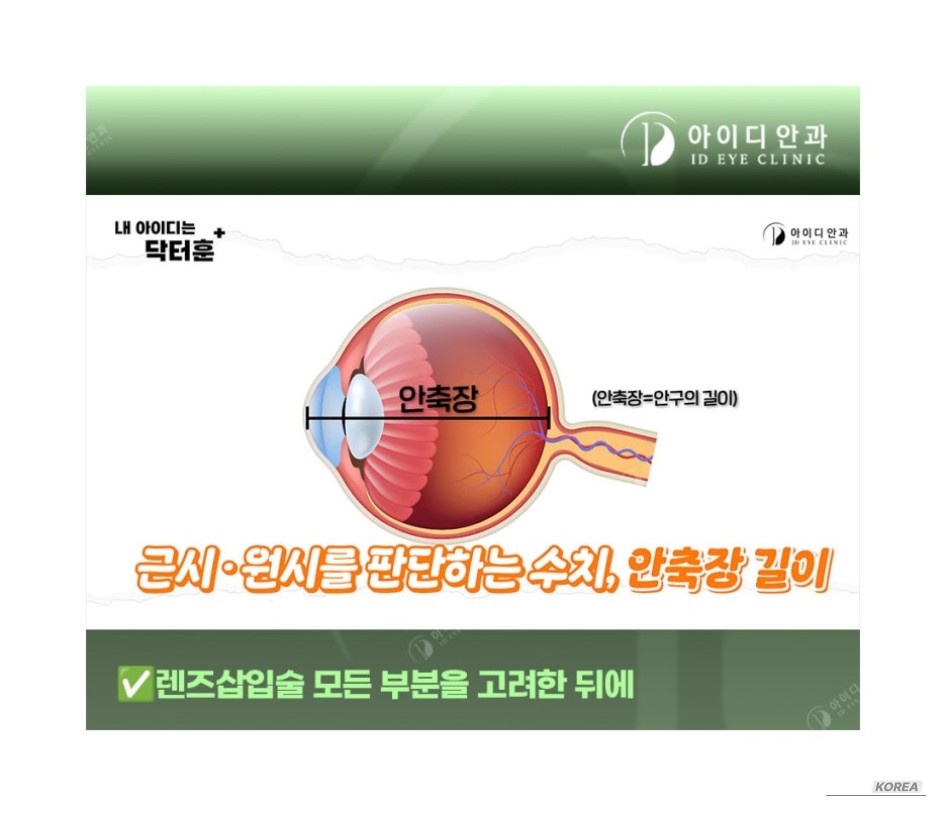
Lens insertion surgery can cause various problems if the internal space of the eye and the size of the lens do not match. Therefore, for safe and satisfactory lens insertion surgery, it is important to pay attention to determining the type, power, and size of the lens that is right for you.
“Considering All Aspects of Lens Insertion Surgery”
With lens insertion surgery, there is a risk of acute glaucoma if the lens is too large, and conversely, there is a risk of traumatic cataracts due to crystalline lens friction if it is too small. Therefore, it is necessary to check whether the medical staff is skilled in order to expect good results.
Therefore, if you are considering lens insertion surgery, you should look at various aspects such as whether they recommend lenses suitable for each individual's different eye conditions, whether they perform accurate and thorough eye exams to check the internal condition of the eye, whether experienced medical staff perform the surgery directly, and whether they operate a systematic post-management program in order to expect more satisfactory results.
As it is a delicate vision correction surgery that requires a high degree of technical skill and judgment, it is wise to make a careful decision so that you can enjoy better vision with the right choice.
Also, it is more desirable to check and compare the lens insertion surgery recovery period and the procedure, and then find an ophthalmology clinic that provides accurate diagnosis and personalized correction, as this can prevent clear vision and side effects.
Thank you for reading the long article. This has been Kim Joong-hoon, head director of Gangnam ID Eye Clinic.





































Source :https://blog.naver.com/tkatlrltkatl/224083558874
No comments yet.