Why There's So Much Talk About Side Effects of Vision Correction Surgery


Hello, this is Bright Eye Clinic.
Having clear vision is a very important part of life.
That's why people with poor eyesight have to wear glasses or contact lenses.
Glasses are a popular vision correction tool because they are affordable and easy to buy.
However, they can be inconvenient because they fog up in temperature changes or when water splashes on them, obscuring your vision.
There is also the risk of eye and face injuries from falls or collisions.
Contact lenses can improve upon the inconveniences of glasses.
However, they are difficult to manage and can cause dry eye or conjunctivitis.
Vision correction surgery can free you from the inconvenience of these tools.
However, many people hesitate because of the numerous cases of side effects and complications.
Side effects and complications after vision correction surgery are due to suitability and aftercare.
Even if a vision correction procedure has proven medical technology, you may experience side effects if it is not suitable for your individual eye health.
Side effects and complications can also occur if you do not take care of yourself after a successful surgery.
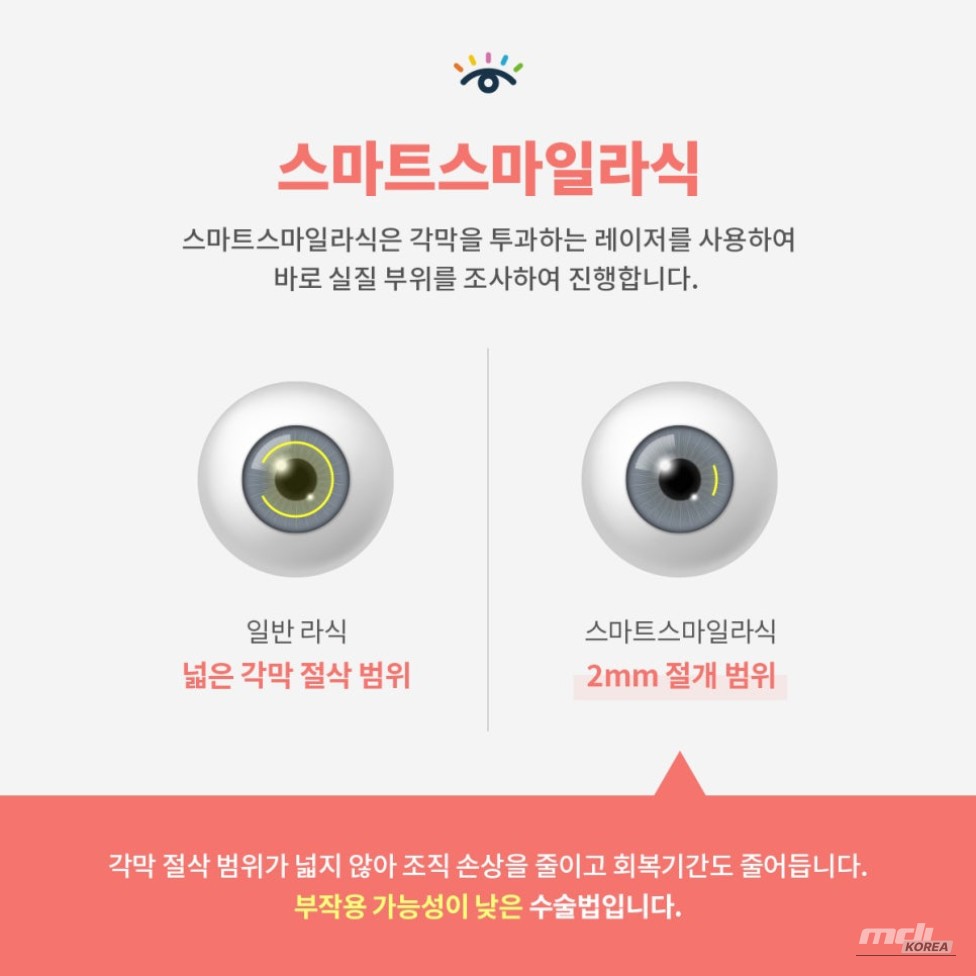
Also, a large corneal ablation range can be a problem.
Today, we're going to talk about Smart Smile LASIK, which reduces tissue damage and recovery time, minimizing worries about side effects.
"Types of Vision Correction Surgery"
The most representative vision correction procedures are LASIK and LASEK.
LASIK and LASEK have been performed for a long time, and many people are satisfied with their vision correction effects.
However, as they are early correction surgery methods, there is a clear difference from Smart Smile LASIK.
LASIK involves creating a flap in the cornea, opening it, and then irradiating the stroma with a laser.
After the laser irradiation is complete, the opened flap is closed to complete the surgery.
Because LASIK involves opening and closing your own corneal tissue, the recovery period is relatively short.
LASEK involves removing the corneal epithelium itself and then irradiating the stroma with a laser.
After laser irradiation, a protective lens is placed over the eye to complete the surgery.
Because LASEK removes the corneal epithelium, the recovery period is longer.
Smart Smile LASIK uses a laser that penetrates the cornea.
Therefore, you do not have to go through the process of creating a corneal flap or removing the epithelium.
"What is Smart Smile LASIK?"
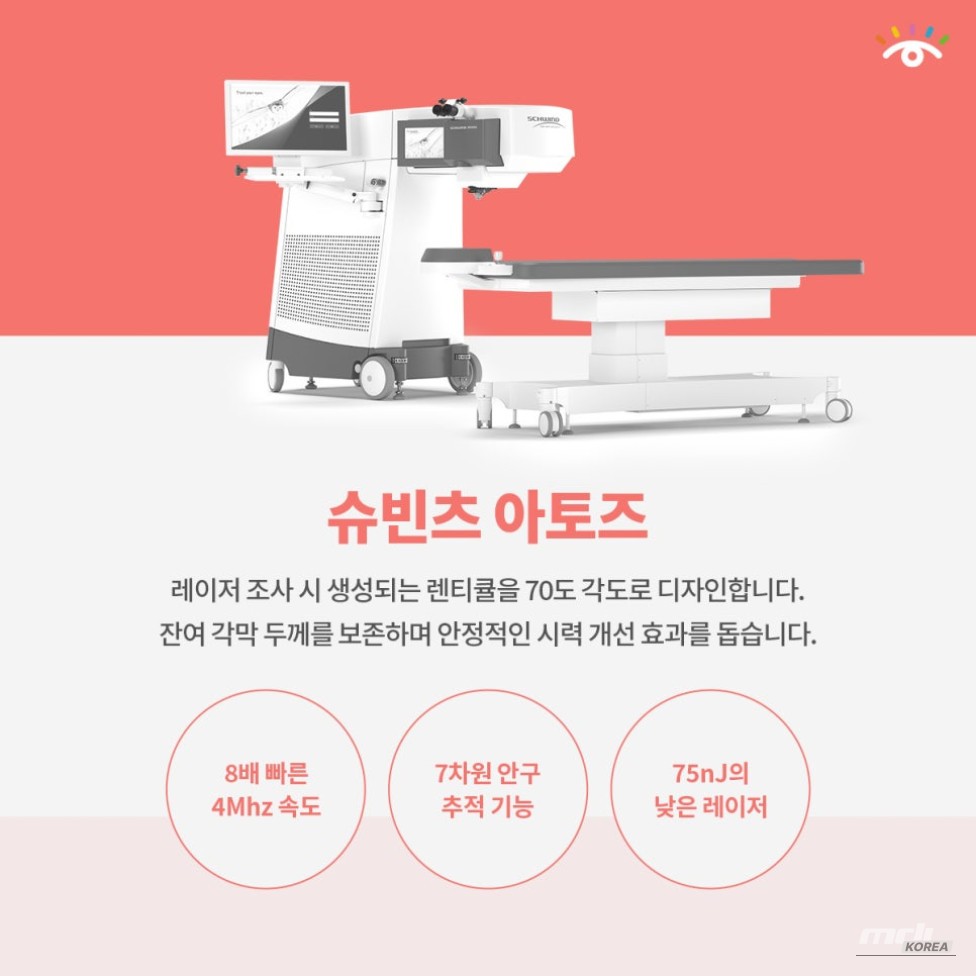
Smart Smile LASIK can skip the corneal ablation process because it uses the Atos laser equipment.
Because this is a laser that penetrates the cornea, it leaves the patient's cornea intact and proceeds by directly irradiating the stroma.
Smart Smile LASIK leaves the cornea intact and completes the surgery by removing the lenticule (a piece of stroma created by irradiating the stroma) created after laser irradiation.
As a result, the incision range during the Smart Smile LASIK procedure is only 2mm for lenticule removal.
Using Atos equipment minimizes tissue damage, resulting in a shorter recovery period and healthier eyes.
"With Advanced Technology"
Smart Smile LASIK designs the lenticule created during laser irradiation at a 70-degree angle.
The 70-degree angle of the lenticule helps maintain firmness in the direction of blinking.
It also preserves the residual corneal thickness and helps to stabilize vision improvement.
The Atos laser equipment irradiates the stroma at a speed of 4Mhz, reducing heat damage.
Laser heat energy uses a minimum of 75nJ of low energy to create a smoother surface.
The advantage of Atos equipment is its 7-dimensional eye-tracking function that can compensate for eye diffraction.
This is a technology that predicts and compensates for the patient's eye trembling or moving slightly during surgery.
Adding eye-tracking technology to vision correction surgery can prevent problems such as corneal opacity and corneal expansion.
The 7-dimensional eye-tracking function ensures stable and clear vision.
The change in the astigmatism axis when lying down and sitting is called ocular cyclotorsion.
The reason why astigmatism correction is difficult when performing vision correction surgery is due to ocular cyclotorsion.
Smart Smile LASIK implements Sirius equipment together with Atos to correct ocular cyclotorsion and more precisely correct ultra-high myopia and high astigmatism.
"Because Aftercare is Also Important"
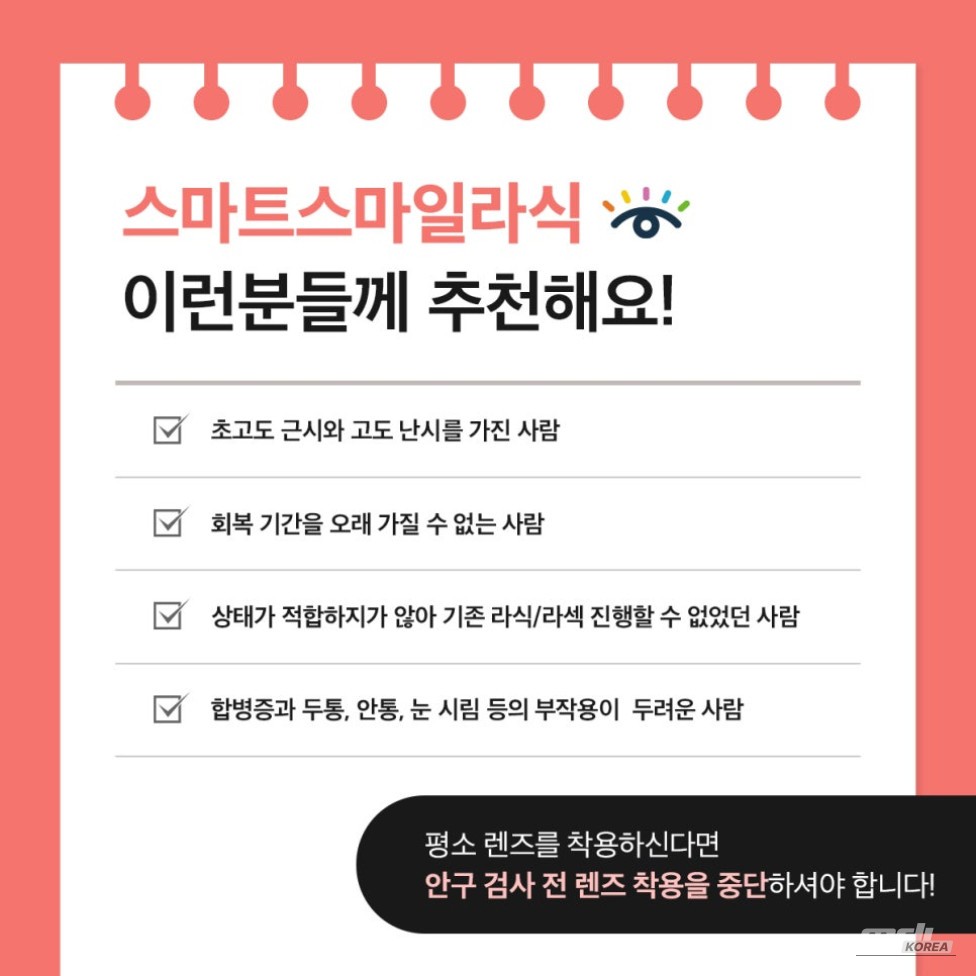
Smart Smile LASIK is preferred because it is effective even for people with ultra-high myopia and high astigmatism.
It may be suitable even if you could not undergo conventional LASIK/LASEK because your corneal thickness or other conditions were not suitable.
It is also recommended for those who cannot afford a long recovery period or who are afraid of side effects such as complications, headaches, eye pain, and eye irritation.
However, it can only be performed if a thorough eye examination is performed before surgery and it is determined that Smart Smile LASIK is suitable for your individual eye condition.
If you normally wear lenses, you must stop wearing them before the eye exam.
Soft lenses should be discontinued for 3 days, astigmatism correction lenses for 6 days, hard lenses for 9 days, and Dream lenses for more than a month.
We ask that you follow these instructions to ensure your eye health and to clearly determine your suitability, even if it is cumbersome.
Our clinic helps you follow the necessary precautions before and after surgery.
We are responsible for aftercare as much as the surgery process, so if you are looking for a reliable eye clinic, please meet our medical staff.



Source :https://blog.naver.com/oklasik3/223820826460
No comments yet.