Vision Correction Surgery for Improved Eyesight



Hello, this is Bright St. Mary's Eye Clinic.
In modern society, many people experience deteriorating eyesight due to frequent use of smartphones and computer screens.
When glasses or lenses become uncomfortable in the pursuit of clear vision, vision correction surgery may be considered.
Indeed, various corrective surgeries such as LASIK, LASEK, and SMILE LASIK have been developed, opening up ways to restore vision more comfortably than before.
However, because everyone's eye condition is different, it is important to carefully determine which vision correction surgery is right for you.
If the cornea is thin or nearsightedness/astigmatism is severe, surgeries like LASIK or LASEK may be difficult.
This is because it may be difficult to ensure sufficient safety in the process of creating a corneal flap or removing the epithelium.
However, this does not mean you have to give up on vision correction surgery.
One option that these individuals can consider is ‘lens insertion surgery.’
Today, we will learn more about lens insertion surgery.
"What is Lens Insertion Surgery?"
Lens insertion surgery is a method of improving vision problems by ‘inserting a manufactured lens inside the eye,’ unlike LASIK or LASEK, which correct vision by cutting the cornea.
This method is characterized by the ability to correct vision without creating a corneal flap or significantly damaging the structure of the eye.
Lens insertion surgery is mainly suitable for those with high myopia or severe astigmatism, or those who have corneas that are too thin to undergo vision correction surgery such as LASIK or LASEK.
The inserted lens is custom-made by analyzing the patient's eye condition and degree of refractive error, and is mainly located behind the iris or in the space in front of the crystalline lens.
The principle is that the inserted lens correctly refracts light, helping to form a clear image on the retina.
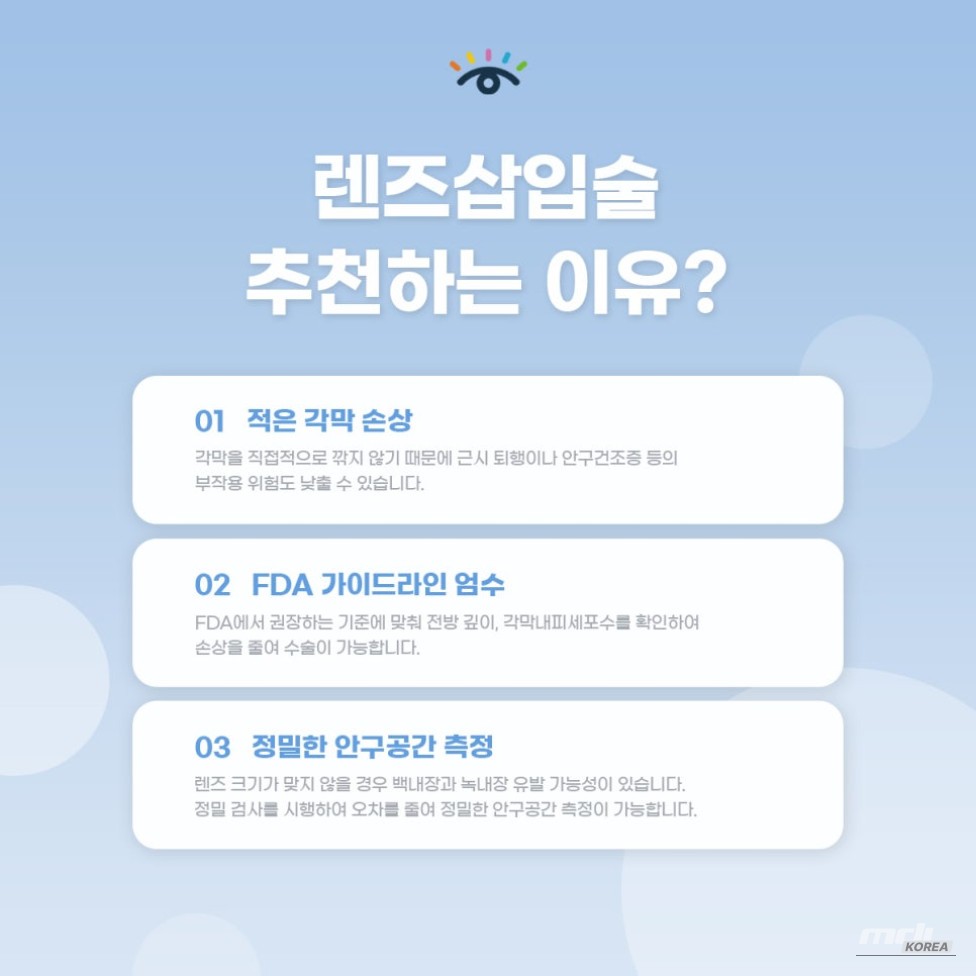
"Reasons to Recommend Lens Insertion Surgery"
Minimal Corneal Damage
In cases of extremely high myopia or high myopia, it is often impossible to perform vision correction with a general laser because the amount of cornea that needs to be cut is large.
However, because lens insertion surgery involves manufacturing and inserting a lens that is tailored to the individual's prescription, it is possible to correct vision while reducing the side effects of corneal ablation.
In addition, because the cornea is not directly cut, the risk of side effects such as myopia regression or dry eye can be reduced.
Because there are various types of lenses, there is an advantage that high astigmatism can also be corrected.
Strict adherence to FDA guidelines
In the case of lens insertion surgery, the folded lens must be unfolded under the widened pupil.
In this process, the skill of the medical staff is important to insert it into the correct position at once so that the position is not reversed.
Our hospital can perform surgery with reduced damage by checking the anterior chamber depth and corneal endothelial cell count in accordance with the standards recommended by the FDA.
Precise measurement of intraocular space
If the lens size is not correct after surgery, there is a possibility of causing cataracts and glaucoma.
Also, if aftercare is not performed properly, there is a possibility of causing iritis.
If the astigmatism axis is not correct, vision may not be corrected, which may cause residual astigmatism and dizziness.
Our hospital performs precise examinations to reduce errors and enable precise measurement of intraocular space.
You can choose the appropriate lens for your eye condition and expect clear vision with the correct surgery.
"Are there any precautions after surgery?"
The eyes are sensitive organs, so constant attention is required even after surgery.
Immediately after surgery, your eyes become sensitive and you may feel itching or discomfort.
Even so, you should never rub or touch your eyes.
This is because stimulating the cornea and inside of the eye can increase the risk of inflammation or infection.
Also, for at least the first week after surgery, be careful not to let water hit your eyes when showering, and wash your face by gently wiping around your eyes.
Strenuous exercise, bending over, and lifting heavy objects can increase intraocular pressure, so it is best to refrain from doing so for about 1 to 2 weeks during the initial recovery period.
In addition, it is necessary to visit an ophthalmologist according to the schedule after surgery to check the eye recovery process, and even if you do not feel any abnormal symptoms, you should check the condition inside the eye or the lens position through regular checkups.
"Customized surgery suitable for individual eyes"
Lens insertion surgery is a vision correction method that can be performed according to various eye conditions.
However, the cornea thickness, eye structure, and degree of refractive error differ from person to person.
Therefore, a thorough examination is essential for customized surgery.
Our hospital meticulously analyzes the patient's eye condition and lifestyle through a total of 15 steps and 50 examination processes.
Based on the results, we will guide you on the direction of surgery and the type of lens.
If you have sufficient consultation prior to surgery and consider your lifestyle habits and work environment, you can increase your satisfaction after surgery.
Of course, aftercare is also an essential part even after the surgery is over.
Our hospital continues to communicate with patients and monitors not only the recovery process immediately after surgery but also the long-term eye condition.
We check intraocular pressure, lens position, and changes in vision through regular checkups, and if necessary, provide additional consultations or measures to help you return to your daily life with peace of mind.
In particular, we operate a lifetime responsibility system, so we provide support for reoperation even if vision deteriorates again after surgery.
It is important to remember that eye health does not end with a one-time surgery, but requires continuous management and attention thereafter.
If you have any questions about lens insertion surgery, please feel free to contact us.








Source :https://blog.naver.com/oklasik3/223794276636
No comments yet.