Understanding Monofocal Intraocular Lenses (IOLs) for Cataract Surgery



Hello, this is Bright St. Mary Eye Clinic.
Cataract surgery is a primary method to address blurred vision caused by the clouding of the eye's natural lens due to aging or other factors. The procedure involves replacing the clouded lens with an artificial intraocular lens (IOL), restoring clear vision.
Today, we will focus on monofocal IOLs, exploring the surgical process, characteristics, advantages, and disadvantages.
The Necessity of Cataract Surgery
Cataracts are mainly caused by aging, leading to a cloudy lens and blurred vision.
As cataracts progress, vision becomes increasingly blurred, especially at night or in dim lighting.
This significantly impacts daily life, leading individuals to consider surgery.
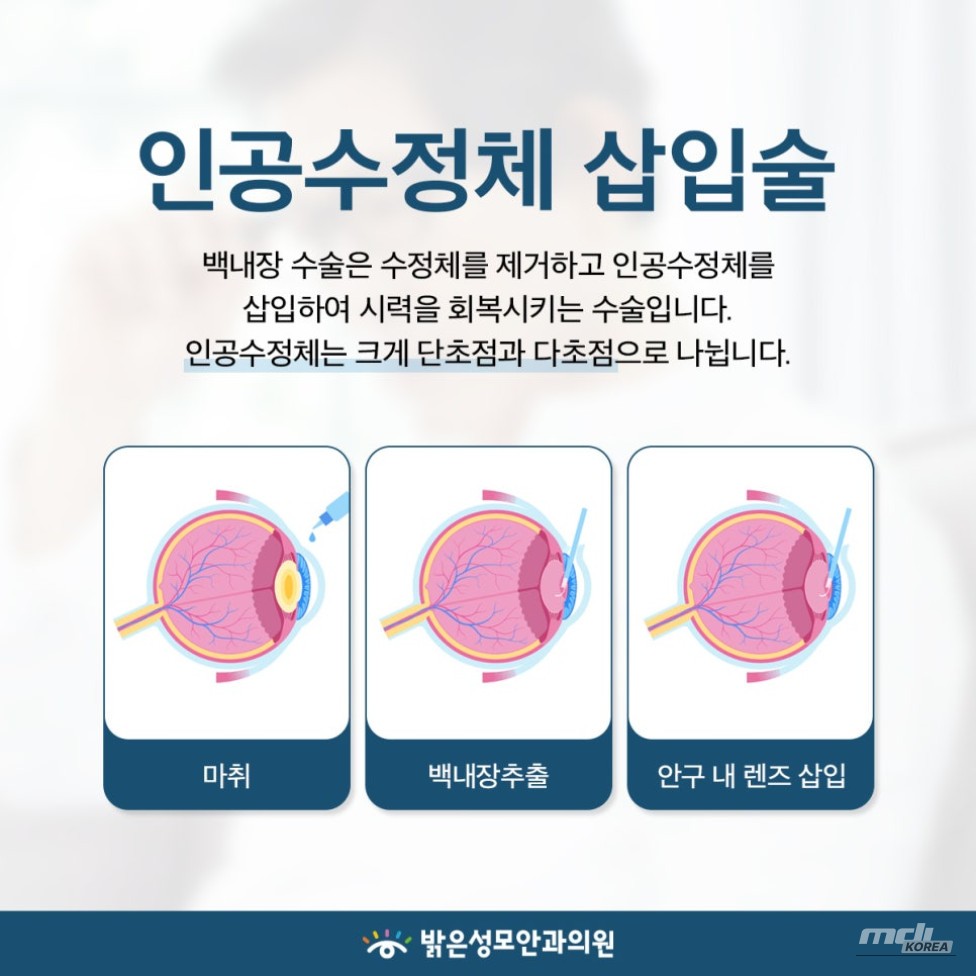
Cataract surgery involves removing the clouded lens and replacing it with an artificial lens to restore vision.
There are several types of IOLs to choose from after surgery, mainly divided into monofocal and multifocal IOLs.
Monofocal IOLs are designed to focus at only one distance, typically correcting either far or near vision.
What are Monofocal IOLs?
A monofocal IOL is designed to provide the best possible vision at a single, specific distance.
Implanting this lens allows focusing on either near or far vision.
For example, if you choose to focus on distance vision, distant objects will be clear, but close-up objects may appear blurry.
Monofocal IOLs are technically simpler and offer stable postoperative results, making them suitable for many patients.
They are often recommended for patients whose occupations or lifestyles require excellent distance vision.
Advantages of Monofocal IOLs
1. Cost-Effective
Monofocal IOLs are relatively less expensive than multifocal or toric IOLs (for astigmatism correction).
In many regions, health insurance covers monofocal IOLs, reducing the financial burden.
2. High Stability
Because monofocal IOLs have a single focal point, predictable vision restoration is possible after surgery.
The consistent and stable vision recovery leads to high patient satisfaction.
3. Minimal Postoperative Discomfort
Compared to multifocal IOLs, monofocal lenses cause less glare or halos, which is a significant advantage.
This reduces discomfort, especially during night driving.
4. Simple Surgical Procedure
Monofocal IOL surgery is simpler and faster than multifocal IOL surgery, leading to a quicker recovery.
But it would be a lie if there were only advantages, right? Let’s find out about the disadvantages for an accurate choice.
Disadvantages of Monofocal IOLs
1. Focus on Only One Distance (Near or Far)
Since monofocal IOLs can only focus at one distance, you may need glasses or reading glasses for clear vision at all distances.
For example, if you choose to focus on distance vision, you may need reading glasses for reading or using your smartphone.
2. Limited Options
Monofocal IOLs only provide a single focus, which may not satisfy patients who desire the advanced features of multifocal or toric IOLs.
3. Limited Astigmatism Correction
Basic monofocal IOLs do not correct astigmatism. Patients with astigmatism may need additional toric lenses or glasses after surgery.
When are Monofocal IOLs Suitable?
Monofocal IOLs are particularly recommended for patients who want to restore distance vision or whose daily activities involve more distance vision than reading.
This includes people who enjoy outdoor activities or office workers who do not spend much time on computers.
Conversely, those who frequently engage in near work, such as reading or using smartphones, may consider monofocal IOLs focused on near vision or multifocal IOLs.
Monofocal IOL Surgery Process and Recovery
Monofocal IOL surgery is generally simple and quick, performed under local anesthesia.
Before surgery, rest your eyes and take prescribed antibiotics to prevent infection.
After surgery, rest and avoid getting water in your eyes for a certain period. Wearing protective glasses when going out is recommended.
Regular follow-up visits are necessary to monitor your condition and make additional vision corrections if needed.
Since vision stabilization is crucial during the initial recovery period with monofocal IOLs, strictly follow your doctor's instructions.
Precautions When Considering Monofocal IOLs
The most important factor when considering cataract surgery is choosing the right IOL for your vision needs.
Monofocal IOLs are cost-effective and offer stable recovery, but they do not correct both near and far vision.
Therefore, it is crucial to choose either distance or near vision based on your lifestyle and needs.
Also, consider the possibility of needing glasses after surgery, and consult with your doctor about multifocal options if needed.
Conclusion
Monofocal IOLs offer stable vision after cataract surgery and are a suitable choice for many patients due to their predictable results.
However, since they only provide one focal point (near or far), careful consideration of your lifestyle and vision needs is essential.
If you have any further questions, please feel free to ask!













Source :https://blog.naver.com/oklasik3/223883266286
No comments yet.