Understanding LASIK Cost and SMILE Surgery



Considering LASIK surgery costs?
Q. What is considered a normal intraocular pressure (IOP) reading at an eye clinic?
Generally, a range between 10~21mmHg is considered normal.
Q. My eyes feel dry and gritty when I wake up. Should I see an ophthalmologist?
It could be temporary dryness, but if the symptoms frequently repeat or are accompanied by blurred vision, it's best to consult an ophthalmologist.
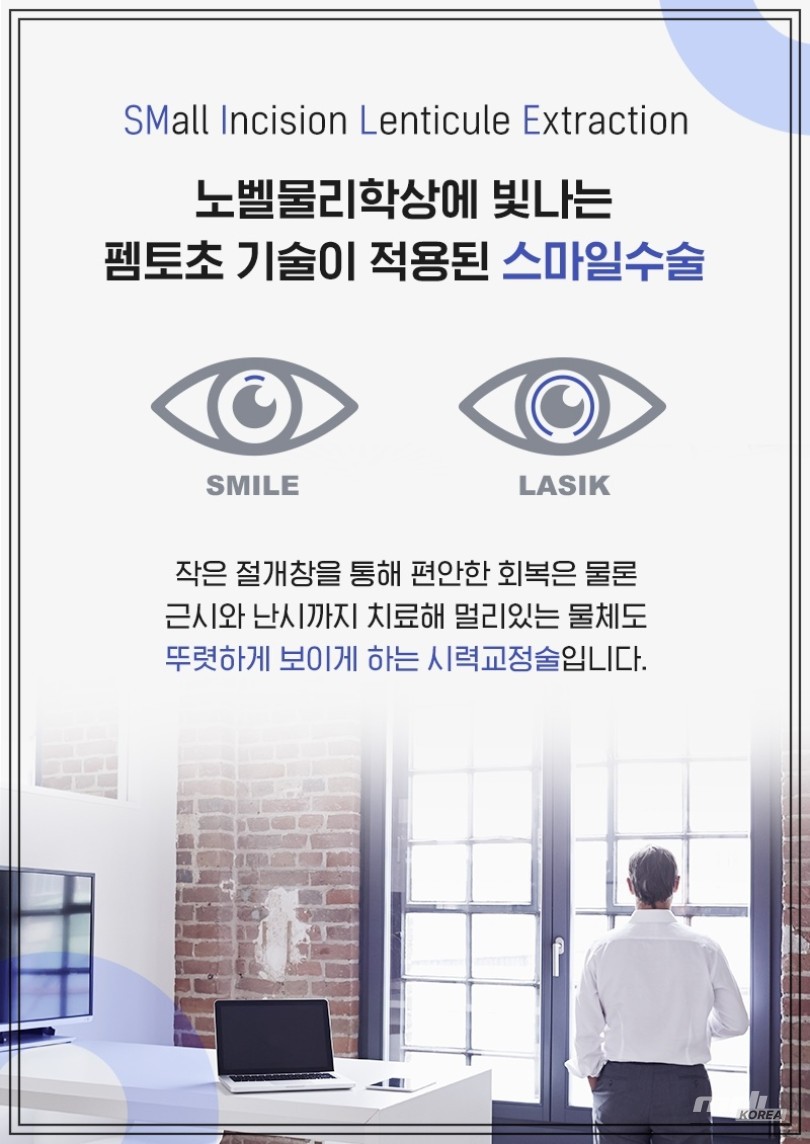
SMILE surgery is a vision correction method that involves creating a thin, circular lenticule within the cornea using a laser and then removing it through a small incision to adjust refractive power. It's characterized by a relatively small incision, which doesn't require opening a large area of the corneal surface. It's used to correct myopia (nearsightedness) and astigmatism. Many people look into LASIK costs as well, so I wanted to discuss the costs and differences together.
Myopia and astigmatism can occur when the refractive power of the cornea doesn't match the length of the eye, preventing light from focusing correctly on the retina. These conditions can be corrected with glasses or contact lenses, but if long-term wear is uncomfortable or there are occupational limitations, surgical correction should be considered.
Because SMILE surgery doesn't create a corneal flap, it can be a relatively stable option for people who frequently engage in intense physical activity or have a habit of rubbing their eyes.
However, careful consideration is needed in cases of thin corneas, suspected keratoconus, progressive astigmatism, or unstable diabetes control. Immediately after surgery, symptoms such as foreign body sensation, glare, and fluctuating focus may occur. Recovery speed varies from person to person, and nighttime glare may be temporarily prominent. If dryness is present, blurring may recur.
These changes usually subside over time, but the duration and severity vary greatly among individuals. When choosing a procedure based on cost, it's more practical to consider recovery sensation and lifestyle together. The diagnostic process is relatively thorough.
An autorefractor and cycloplegic refraction are used to confirm the exact refractive error, and corneal topography and tomography are used to assess the thickness distribution and shape of the cornea. We check whether the corneal thickness is sufficient, whether the residual thickness exceeds safety standards, and whether the corneal curvature changes are abnormal.
Pupil size and reaction in dark conditions, dry eye indicators, basal tear film, and meibomian gland status are also checked. A dilated fundus examination is performed to check the condition of the retina and optic nerve and to check for other overlapping diseases. These results are combined to determine surgical suitability and target refraction. Even when considering cost comparisons, the results of this stage are the primary criteria for selecting a surgical method.
As a treatment method, SMILE surgery is performed one eye at a time after topical anesthesia. A laser creates a small lenticule inside the cornea, and the fragment is separated and removed through an incision of about 2-4mm. In many cases, both eyes are treated on the same day, and the procedure takes only a few minutes per eye. When correcting astigmatism, it is important to accurately align the axis.
After surgery, it is known that returning to daily life is relatively quick due to the structural advantage of not significantly affecting the corneal surface, but this can vary depending on the individual's eye condition and work environment.
Unlike the flap-making method, there is relatively less theoretical concern about trauma, but discomfort such as dryness and nighttime glare may occur. Comparing the SMILE surgery range with LASIK cost inquiries, many places are formed between approximately 2.5 million won and 3.5 million won based on both eyes. The cost of a pre-operative precision examination is often charged separately, and is often presented at around 100,000 to 200,000 won.
The total amount may vary depending on the reoperation guarantee range, software version, laser device maintenance standards, and the number of post-operative management visits. When directly comparing LASIK and SMILE surgery costs, it is more realistic to check the included items together rather than just looking at the simple surgical fee. If the diopter range is high or the astigmatism is large, the plan may change, and it is also necessary to check whether a compensation policy for future minute residual diopters is included.
If the amount of cornea cut is excessive and the remaining thickness is insufficient, shape changes may occur over time, so it is necessary to secure a conservatively calculated safety margin. If there is dryness, the symptoms may become more pronounced, so the tear film condition should be carefully checked during the examination stage. Nighttime light scattering may be prominent in people with large pupil sizes, so expectations should be adjusted.
If the previous lens wearing period was long, it was necessary to take a sufficient rest period before the examination and then check the values. Rather than rushing to a decision based only on LASIK cost, a precise suitability determination and surgical plan should come first to get closer to predictable results. SMILE surgery has a structural feature of refractive correction through a small incision, and the suitability assessment at the examination stage greatly influences the treatment results.
When inquiring about costs, it was more reasonable to look at the included services, the condition of the equipment and software, the reoperation policy, and the scope of follow-up examinations, rather than simply comparing unit prices based on LASIK cost inquiries. Prioritizing a design tailored to your eye condition and lifestyle, and then adjusting the amount, can help reduce unnecessary trial and error.
Additionally, if you have a history of previous vision correction surgery, you should re-examine the corneal condition in detail and discuss a compensation plan, considering the possibility that a residual diopter may remain meaningfully.
If you review environments such as whether you often work night shifts for a long time or need a precise field of vision from a long distance, the basis for selecting a surgical method may become clearer.
In rare situations where additional correction is needed in the future, surface ablation correction or lens insertion conversion should be discussed when corneal conditions do not allow it. If the myopia diopter has changed significantly recently, a plan should be established after confirming the stabilization period, and if a high-intensity work environment or exam schedule overlaps immediately after, whether or not to adjust the timing should also be determined.




Source :https://blog.naver.com/koikoro/224036622747
No comments yet.