Understanding Cataracts: Early Onset, Symptoms, and Treatment



Hello, this is BGS Myeongseong Eye Clinic.
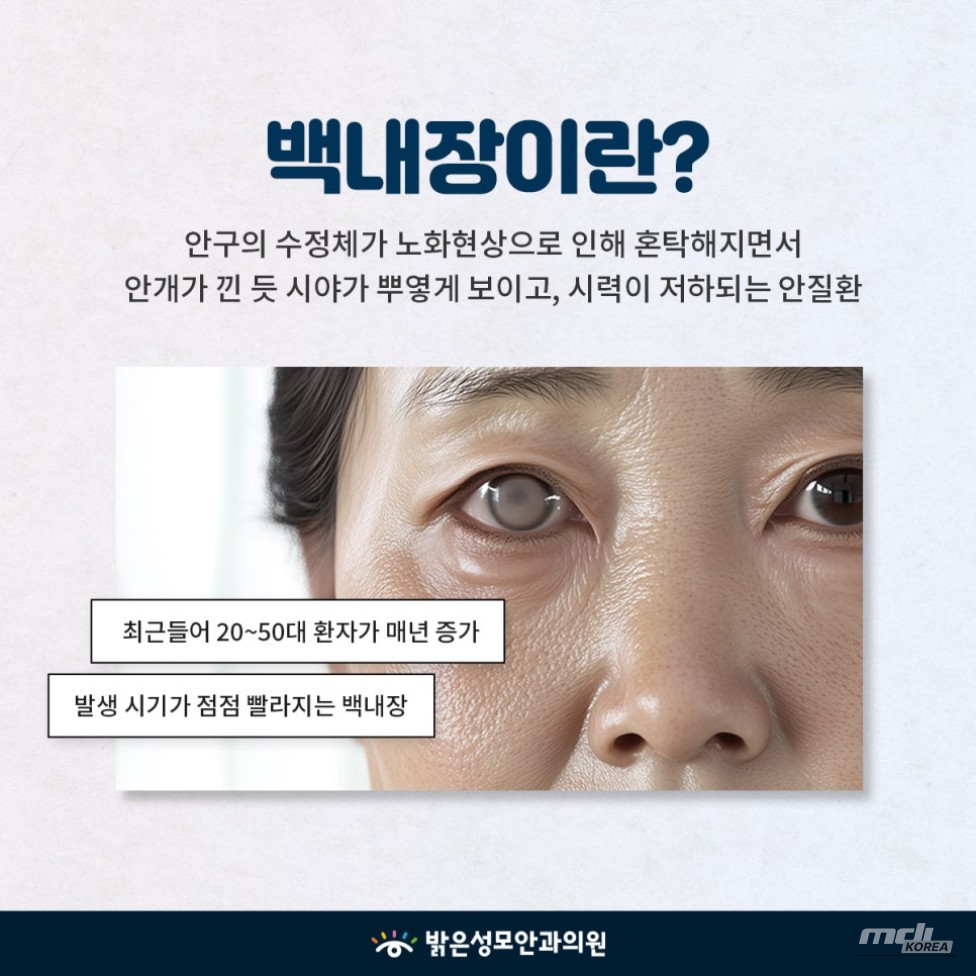
We've recently seen an increase in cataract patients in their 20s to 50s, and the onset of cataracts is occurring at increasingly younger ages. Caution is needed when it appears early in life.
To be cautious, it's important to understand what this condition is, right?
What kind of eye disease is a cataract?
A cataract is an eye disease in which the lens of the eye becomes cloudy due to aging, causing blurred vision as if looking through a fog, and a decline in eyesight.
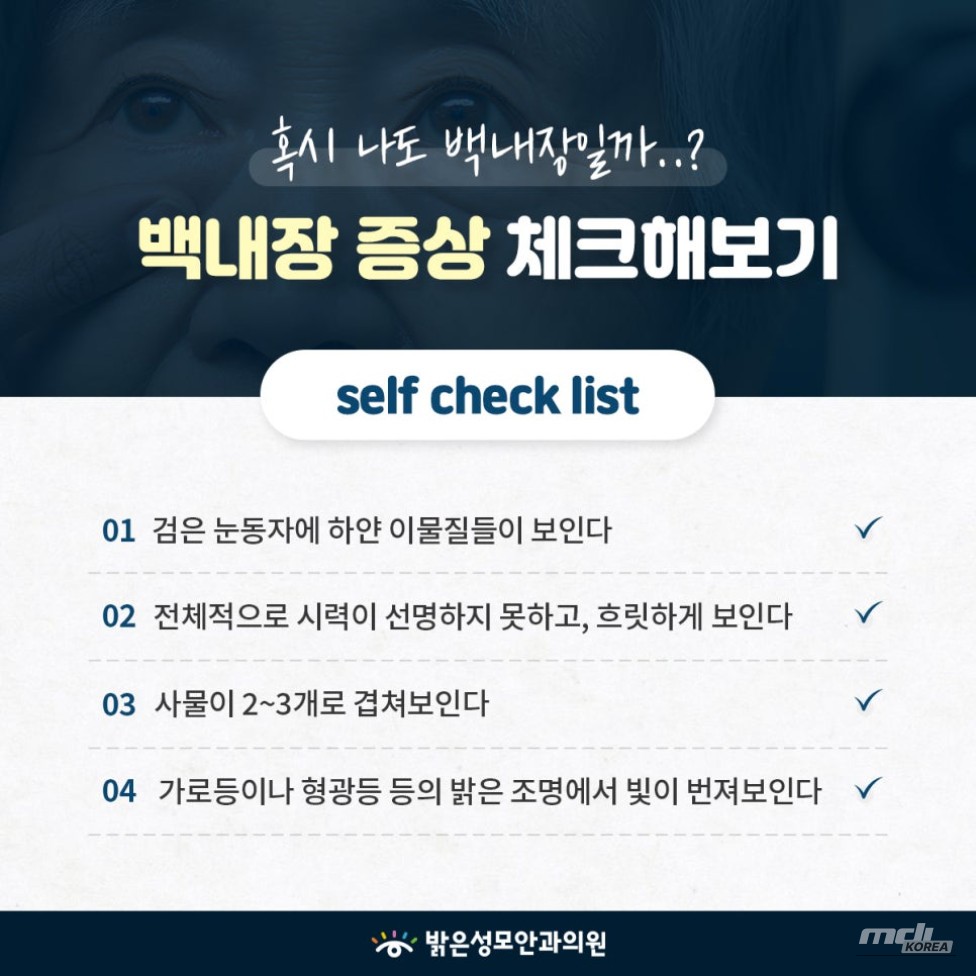
If you experience the following symptoms, suspect cataracts and visit an ophthalmologist for an examination.
Generally, the incidence of cataracts increases with age and as the lens ages.
The lens plays a crucial role in refracting light entering the eye to form an image on the retina.
However, with age, the protein structure of the lens changes and clumps together, leading to cloudiness. When the lens becomes cloudy, light cannot pass through properly, resulting in impaired vision.
Additionally, the accumulation of free radicals in the lens during the aging process is a major cause of cataracts.
Free radicals damage cells and alter protein structures, accelerating the clouding of the lens.
In the case of age-related cataracts, nearsightedness may initially occur due to increased refractive power of the lens. As cataracts progress, it may become difficult to distinguish blue hues.
The incidence of cataracts typically starts to increase after age 40 and rises sharply after age 60.
According to data from the American Society of Cataract and Refractive Surgery,
cataracts develop in approximately 10% to 20% of people between the ages of 40 and 50, while over 70% of people in their 60s and over 90% of people in their 80s experience cataracts.
According to statistics from the Korea Disease Control and Prevention Agency in 2019, the number of cataract patients in Korea increases sharply in those aged 60 and older, with about 3 out of 10 people in their 60s suffering from cataracts.
Cataracts are commonly known to be caused by aging and are primarily seen in the elderly, but there is no single definitive cause.
This means that cataracts can occur due to various factors besides age, just like gray hair can appear at a young age.
According to statistics from the National Health Insurance Service, the number of cataract surgeries has been rapidly increasing every year since 2015, with a notable increase in onset among younger age groups.
Smartphone use is cited as a major cause of cataracts in people in their 20s.
This is because blue light emitted from smartphones and prolonged screen focus put continuous strain on the eyes.
Blue light is short-wavelength, high-energy light that can reach deep into the eye. Prolonged exposure can cause eye fatigue and damage the lens and retina.
In particular, prolonged smartphone use reduces blinking, worsening dry eye and leading to habits such as rubbing the eyes or applying excessive pressure.
Cataracts that develop in the 20s may or may not have a specific cause.
The most common cause is trauma, where the lens ruptures or is damaged, leading to severe cataracts.
Sleeping face down with the eyes pressed against a hand or arm, or continuously rubbing the eyes, can also affect the development of cataracts.
These actions put repetitive pressure on the eyes, irritating the structures inside, especially the lens.
This can cause minor damage or rupture to the anterior capsule (the sac in front of the lens), and the accumulation of such damage increases the likelihood of developing cataracts.
In the case of cataracts in the 20s, most patients experience gradual vision loss without any particular symptoms such as eye discomfort or discharge.
However, in rare cases, complications from cataracts can lead to other abnormalities such as glaucoma, which may be accompanied by pain and other symptoms.
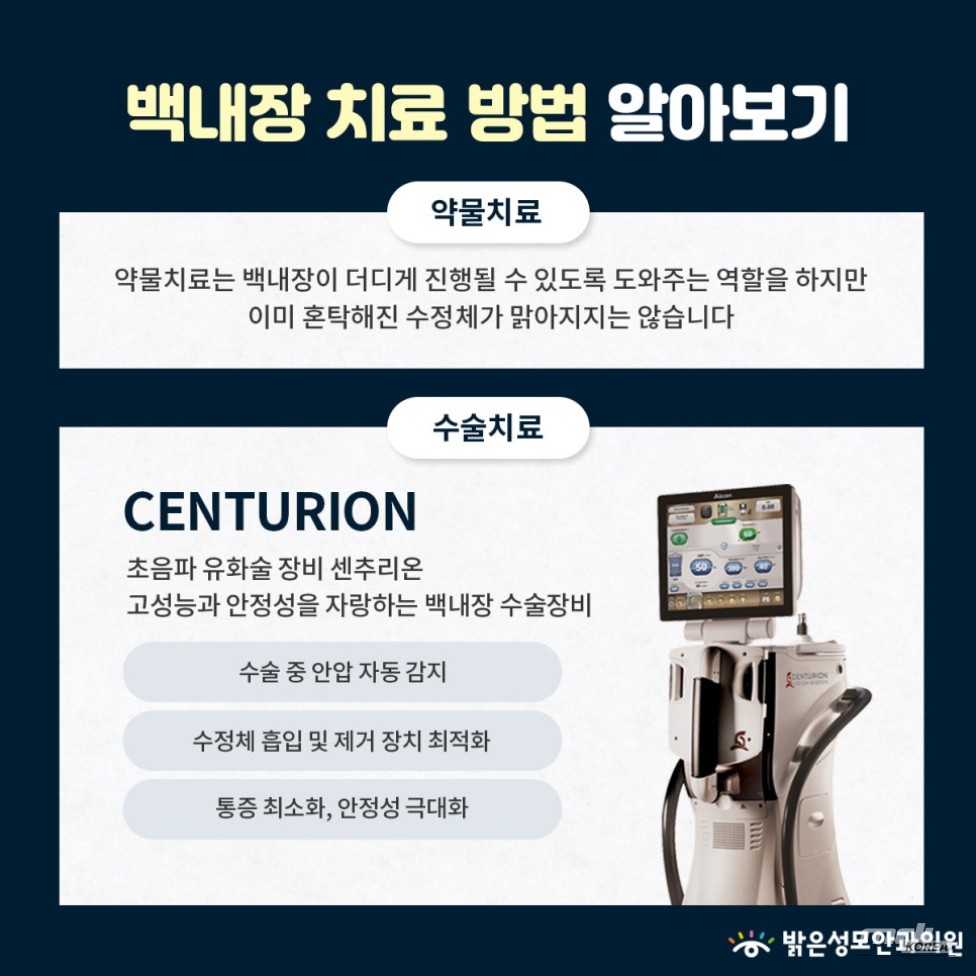
The treatment methods for cataracts mainly include medication and surgery.
Medication can help slow down the progression of cataracts, but it cannot restore clarity to a lens that has already become cloudy.
Therefore, surgery can provide a more definitive treatment effect.
Surgery is relatively simple and safe, with a high rate of vision recovery after the procedure.
The decision on whether to have surgery is made by comprehensively considering the current state of the cataracts, the cause of vision loss, and other factors that have affected vision development.
If the potential benefits a patient can gain from surgery are not significant, other supportive vision management methods may be chosen instead of surgery.
Cataracts can be difficult to detect in the early stages because symptoms are mild or not obvious. Usually, there are no pain or specific symptoms other than visual impairment, and the condition may progress gradually over months or years.
Cloudy vision caused by lens opacity is often mistaken for a temporary condition due to a tiring daily life and left untreated.
If left untreated, cataracts will not heal naturally and symptoms will worsen, potentially leading to blindness in severe cases.
Therefore, even young people and those who are generally healthy should undergo regular check-ups about once a year to prevent eye diseases and maintain their daily lives.
However, conversely, medication can be used to treat cataracts that progress slowly or do not significantly affect daily life.
At BGS Myeongseong Eye Clinic, we only recommend cataract surgery to those who truly need it.
Also, choosing the right intraocular lens (IOL) tailored to your lifestyle is very important for cataract surgery.
BGS Myeongseong Eye Clinic has skilled medical staff and a variety of IOLs, enabling customized cataract surgery.
We insert customized lenses that consider each person's unique eye characteristics, individual lifestyle, medical history, hobbies, and future plans.
Because professional care from medical staff is needed during the 6-hour golden time for recovery after surgery, we operate a same-day admission room (daycare center) for those who need hospitalization.
We also provide professional treatment for conditions such as dry eye that may temporarily occur afterward, and continuous follow-up care with assigned medical staff.
Our medical staff at BGS Myeongseong Eye Clinic always prioritize the eye health of our patients.
Since accurate measurement of the required IOL power before surgery is the most important factor, we conduct approximately 60 types of 1:1 precision examinations to prevent even 1/100th of an error.
We check for any abnormalities in all parts of the eye, from the cornea to the optic nerve of the retina, and assess individual measurements.
Various precision examinations are conducted, including the patient's vision, corneal condition, retinal thickness, and pupil size.
Through this, we provide consultations on surgery eligibility, post-operative corrected vision, and the most suitable surgical method for your eye condition.
We have various precision examination equipment and the latest surgical equipment.
Our ophthalmologists also have extensive clinical experience, so you can expect stable results.
We operate on an appointment basis, so please make an appointment before visiting and feel free to contact us with any questions. :)








Source :https://blog.naver.com/oklasik3/223963896872
No comments yet.