The Risks of Eye Diseases and the Importance of Early Management


The human eye is a very important organ, so precious that there's a saying, "If the body is worth a thousand nyang, the eyes are worth nine hundred."
However, in modern society, our eye health is threatened by environmental pollution, fine dust, bacteria, and the increased use of electronic devices such as smartphones and computers.
This has led to an increasing trend in various eye diseases such as glaucoma and macular degeneration. In particular, age-related cataracts are affecting the vision of not only the elderly but also those in their 40s and 50s.
The eye has a structure similar to a camera. The lens, like a camera lens, transmits light to form an image on the retina.
If the lens becomes cloudy due to various reasons, light cannot pass through properly, resulting in cataracts, which blur vision.
In the early stages, it is difficult to detect cataracts because there is no pain or itching. However, if left untreated, symptoms such as changes in color perception, decreased vision, and light scattering can worsen, and in severe cases, it can lead to blindness.
Cataracts are divided into congenital and acquired types. Congenital cataracts are caused by genetic factors or intrauterine infections, while acquired cataracts are typically age-related cataracts that appear after the age of 50.
This is a phenomenon that occurs as proteins in the lens denature, just as skin and organs naturally age.
Cataracts can also occur in younger age groups, mainly due to strong external shocks or injuries caused by sharp objects.
In addition, certain diseases such as Alport syndrome, atopic dermatitis, and diabetes can cause eye diseases, so caution is needed if you have related conditions.
If you have a family history, you may be affected by genetic factors, so regular check-ups are essential.
Lifestyle habits such as smoking and drinking also increase the risk of developing cataracts, so it is important to maintain good habits for eye health.
Age-related cataracts are more likely to be treated and recovered quickly if detected early. However, they are often discovered late because they are confused with aging or fatigue.
The main symptom is decreased vision, which can be divided into blurred peripheral vision or blurred central vision, depending on the degree of progression.
In particular, it is easy to confuse it with symptoms similar to presbyopia (farsightedness due to aging), so if your vision deteriorates, it is important to have a thorough examination to determine whether it is simply an aging phenomenon.
As cataracts progress, hemeralopia (day blindness), in which vision deteriorates further in bright environments, may appear, and light scattering and glare may worsen.
In addition, double vision, in which objects appear as multiple images, can occur, increasing the risk of falling or injury. In severe cases, changes that are visible to the naked eye, such as the pupil color turning cloudy, may occur, so caution is required.
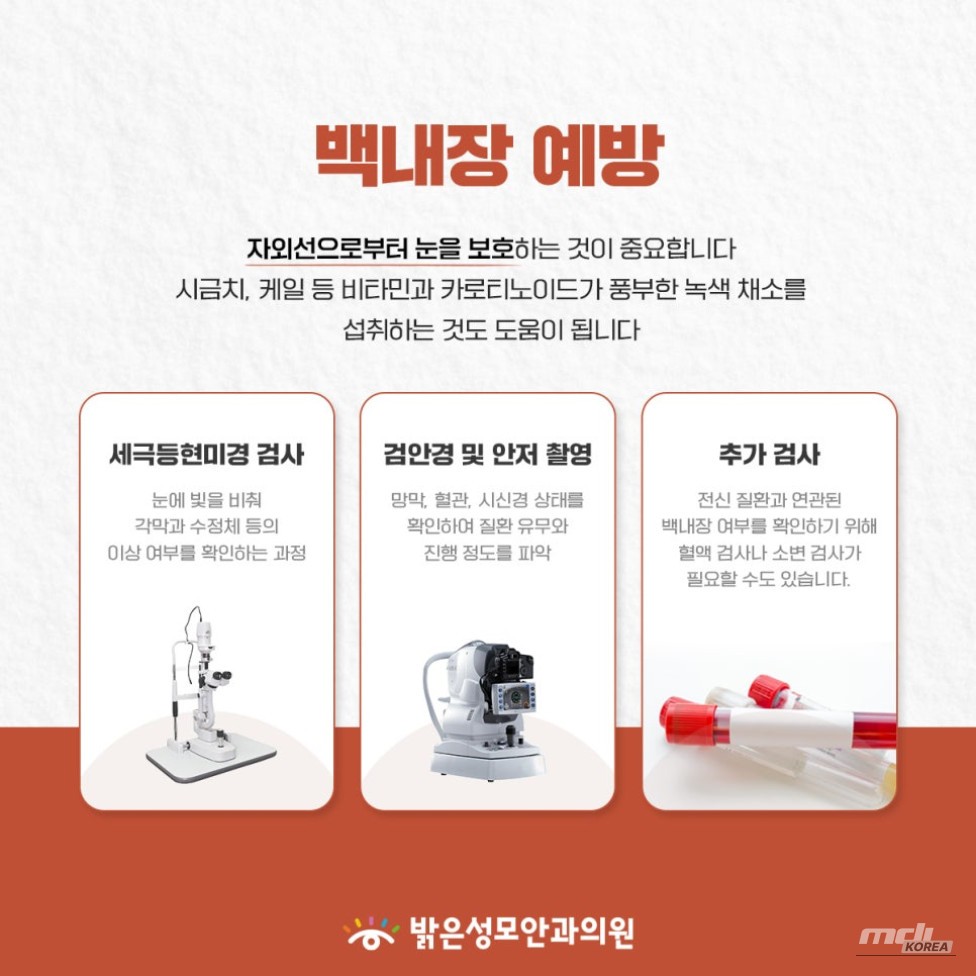
To protect your eye health, it is important to protect your eyes from ultraviolet rays. Wearing sunglasses or a wide-brimmed hat can increase the sun protection effect.
Also, eating green vegetables rich in vitamins and carotenoids, such as spinach and kale, can be helpful.
The most important thing is regular eye exams. In particular, if you are over 50 years of age or have a family history, you should be more proactive in getting screened. The examination process includes visual acuity tests, ophthalmoscopy, fundus photography, and intraocular pressure measurement.
Slit-lamp microscopy is a process of shining light on the eye to check for abnormalities in the cornea and lens.
Ophthalmoscopy and fundus photography check the condition of the retina, blood vessels, and optic nerve to determine the presence and progression of disease.
Additional tests may be necessary to check for cataracts related to systemic diseases such as diabetes or high blood pressure.
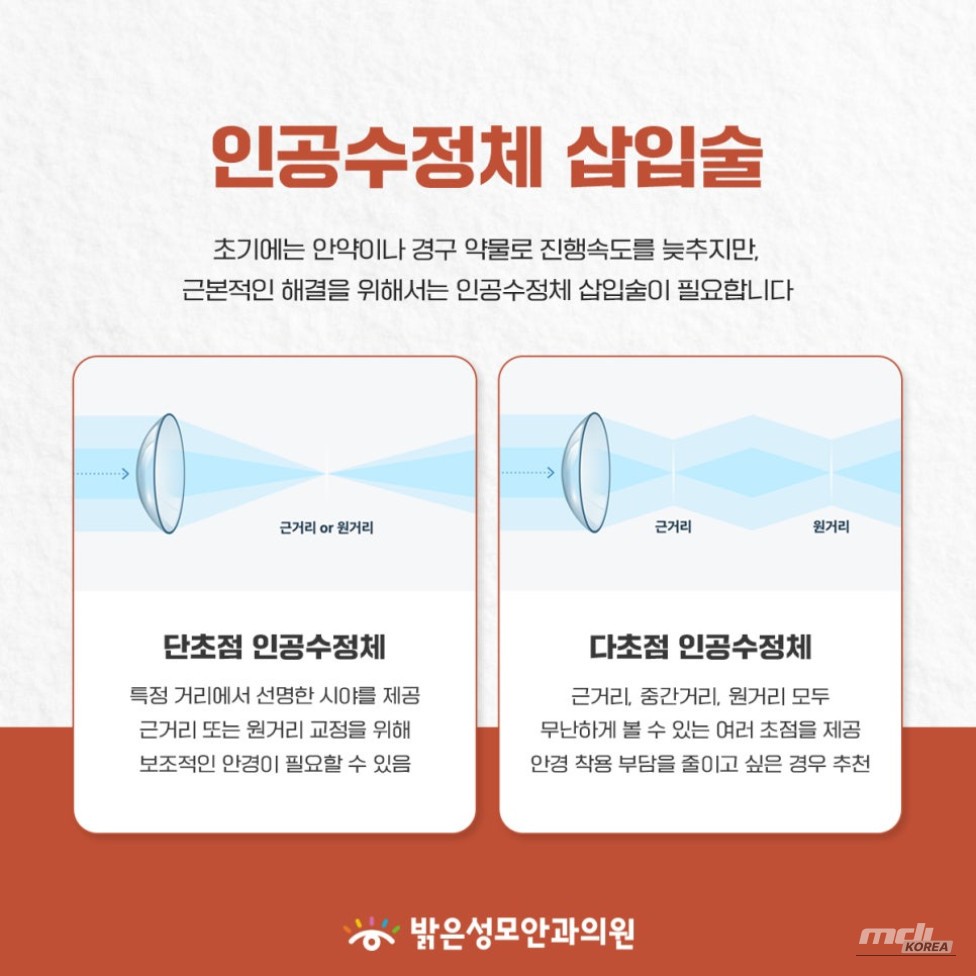
If cataracts are diagnosed, eye drops or oral medications can be used to slow the progression in the early stages, but artificial lens implantation is necessary for a fundamental solution. Recently, various artificial lenses have been developed, and the main types are as follows:
Monofocal Intraocular Lens: Provides clear vision at a specific distance, but may require auxiliary glasses for near or far vision correction.
Multifocal Intraocular Lens: Designed to provide multiple focal points so you can see near, intermediate, and far distances without difficulty. Recommended if you want to reduce the burden of wearing glasses after surgery.
Toric Intraocular Lens: Contains an astigmatism correction function and is suitable for patients with astigmatism. Regular check-ups and management are necessary for recovery after surgery, and it is important to consult with experienced medical staff.
If early symptoms appear, you can visit an ophthalmologist quickly and manage it with non-surgical treatment, so it is recommended that you do not neglect the symptoms and consult with a specialist.
Cataracts are a natural change due to aging, but you can minimize vision loss by preventing and managing them in advance. It is important to protect your eye health through regular eye exams and lifestyle improvements, and if symptoms appear, it is advisable to seek professional medical attention without delay.







Source :https://blog.naver.com/oklasik3/223837261080
No comments yet.