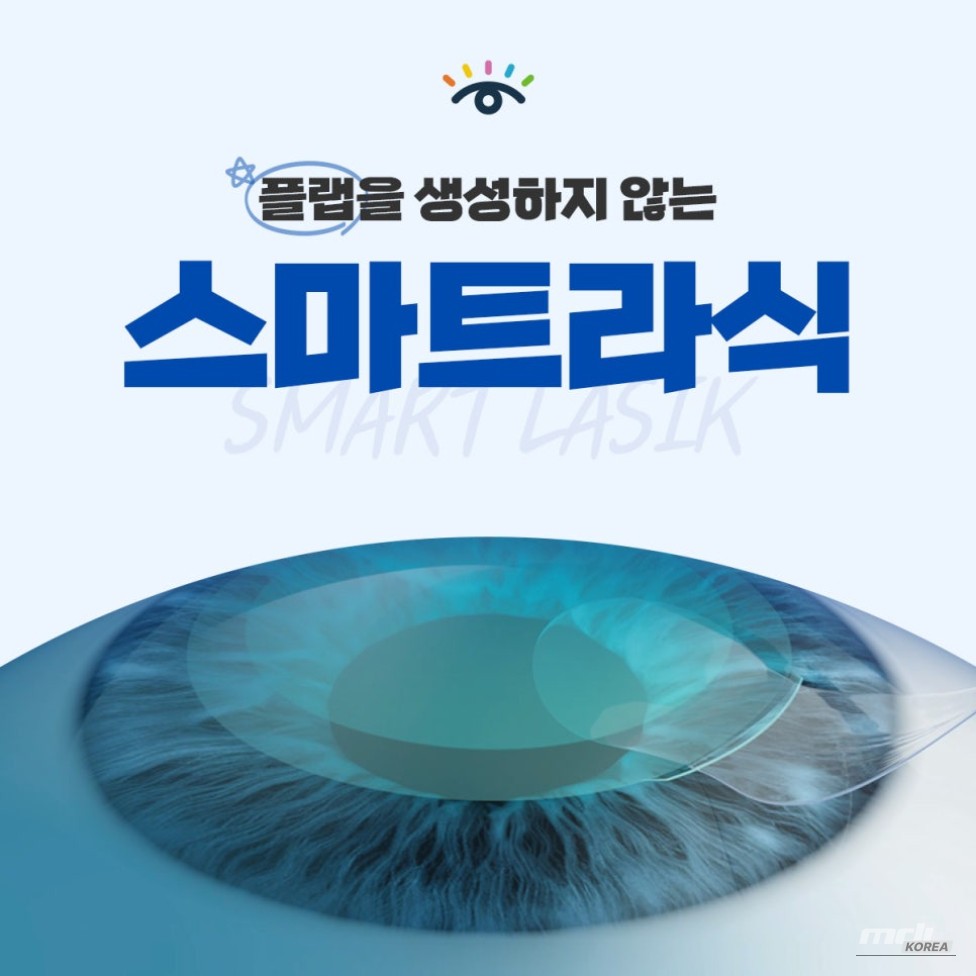
Smart LASIK: A Next-Generation Vision Correction



"Eyeglasses and Lenses That Can't Always Be Used"
Humans rely most heavily on their sense of sight among all sensory organs.
Even the slightest obstruction of vision can lead to fear and difficulty in taking a single step.
People with poor eyesight may experience a similar feeling when they are not wearing glasses or lenses.
In daily life, there are moments when wearing glasses or lenses becomes difficult.
Moreover, glasses can become uncomfortable when they get smudged or fogged up, temporarily blurring vision.
Glasses can also be a safety hazard during sports activities or physical labor.
To alleviate these inconveniences, many consider vision correction surgery.
However, since vision correction surgery involves direct intervention on the eye, it can also cause worry and anxiety.
In the past, there were indeed many cases of side effects or complications.
However, advancements in medical technology have led to new surgical methods that differ from those of the past.
Furthermore, improved equipment performance helps reduce side effects.
Today, we will delve into Smart LASIK, a next-generation vision correction surgery with many advantages.
"Features of Vision Correction Surgery"
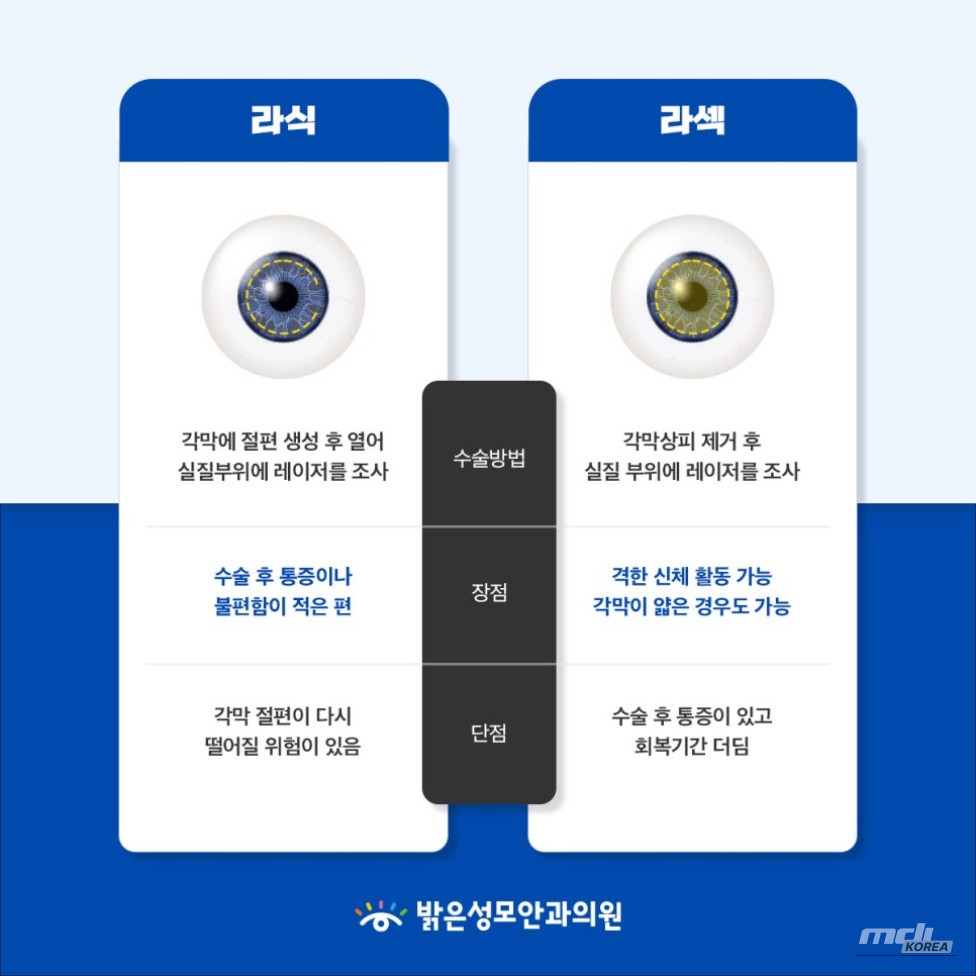
Among vision correction surgeries, LASIK and LASEK are the most well-known.
LASIK involves creating a flap, a kind of lid, on the cornea.
The flap is then opened, a laser is applied to the stromal bed, and the flap is repositioned to complete the procedure.
LASIK can only be performed on individuals with sufficient corneal thickness to allow for flap creation.
Although it generally involves less pain and discomfort after surgery, it has the disadvantage of requiring patients to refrain from strenuous physical activity due to the risk of the corneal flap dislodging.
LASEK involves removing the corneal epithelium and applying a laser to the stromal bed.
After laser treatment, a protective contact lens is placed on the eye to aid in recovery.
LASEK is an option for individuals who are ineligible for LASIK due to corneal thickness.
It is also suitable for people with physically demanding occupations, such as athletes, as it does not pose any issues with strenuous physical activity.
However, the recovery period may be longer than with LASIK, and some individuals may experience pain.
Smart LASIK, which we will explore today, combines the advantages of both LASIK and LASEK.
“Equipment Used in Smart LASIK”
Smart LASIK utilizes the sophisticated laser equipment, Atos.
The Atos equipment enables next-generation vision correction surgery unlike anything before.
A key strength of Smart LASIK is that it does not involve corneal cutting.
Because it uses a laser that penetrates the cornea, the laser can be applied directly to the stroma without epithelial removal or flap creation.
Afterward, a small incision is made in the cornea.
The lenticule created during laser irradiation is then extracted through the small incision.
This lenticule separation method of vision correction significantly reduces corneal damage.
Since there is minimal damage to the cornea and ocular tissue, the recovery period after surgery is short.
Patients should rest on the day of surgery and can resume normal activities within a day or two.
Although it varies from patient to patient, most can drive the day after surgery.
"Why the Correctable Range Has Increased"
Smart LASIK can correct vision in patients with high myopia, very high myopia, and high astigmatism.
This is because Smart LASIK can utilize its unique technology and the features of the Atos equipment.
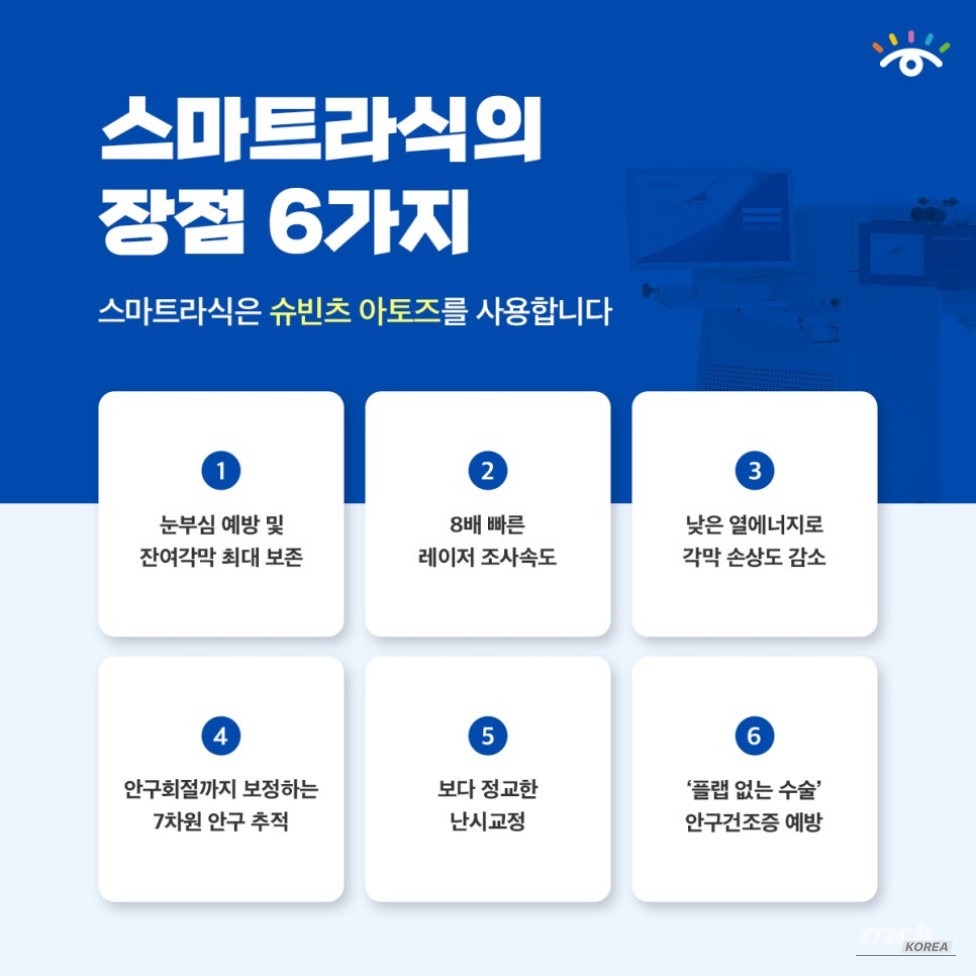
Smart LASIK has six advantages.
First, the lenticule is created and extracted at a 70-degree angle, following the direction of blinking, which preserves a large amount of residual cornea.
This is excellent for preventing side effects such as glare and dry eye, and for protecting eye health.
Second, it has a rapid laser speed.
Because the laser is applied at a speed of 4 MHz, the surgery time is short, and the incidence of corneal thermal damage is reduced.
Third, it uses low heat energy.
The lower the heat energy applied to the eye, the smoother the corneal surface can be made.
Smart LASIK utilizes a low laser energy of at least 75 nJ to create a corneal surface that is much smoother than after surgery.
In addition, because it reduces corneal damage and increases the amount of preservation, it does not significantly affect eye health.
The fourth advantage is that it uses a 7-dimensional eye-tracking function to predict and correct even the slightest eye movements of the patient during surgery.
Fifth, it can correct the astigmatism axis, which changes between when the patient is sitting for an eye exam and when they are lying down for surgery.
This phenomenon is called ocular cyclotorsion.
Conventional vision correction surgery could not correct ocular cyclotorsion, making precise astigmatism correction difficult.
In contrast, Smart LASIK enables precise astigmatism correction, leading to positive results even in patients with high astigmatism.
"An Eye Clinic That Takes Responsibility for Aftercare"
The sixth and final advantage is that it does not create a flap.
A flap is created after corneal incision and is a factor that causes side effects such as dry eye.
Smart LASIK does not create a flap, which shortens the recovery period and prevents side effects.
After a successful and stable surgery, it is important to get regular eye exams.
When going about your daily life, refrain from rubbing your eyes, drinking alcohol, smoking, or engaging in strenuous exercise.
We are committed to providing systematic aftercare with the same dedication we have when performing the surgery.
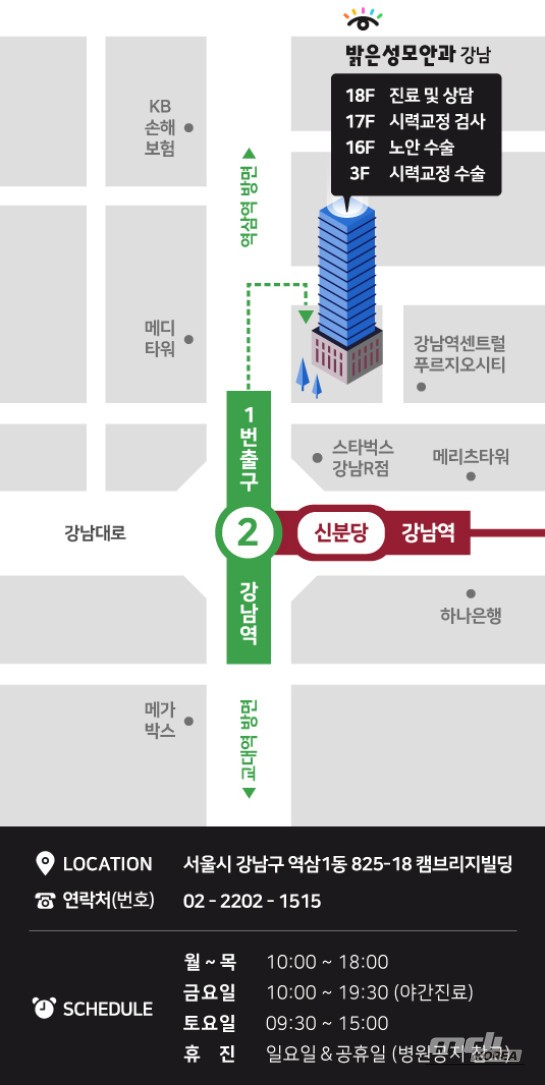
For those who have busy weekday schedules and find it difficult to visit, we also operate late into the evening until 7:30 PM every Friday, so please keep that in mind and consider undergoing a vision correction exam with us.






Source :https://blog.naver.com/oklasik3/223801910383
No comments yet.