LASIK vs. LASEK: All-Laser Vision Correction at Seocho Station Eye Clinic



People receive various information through their five senses—sight, hearing, smell, taste, and touch—in their daily lives. Among these, sight is the most frequently used, and most stimuli and information encountered in daily life are recognized through vision. As such, eyesight significantly impacts the quality of life. If vision deteriorates, it can lead to limitations and inconveniences in daily activities. For this reason, many people have become interested in vision correction surgery, and more are considering it as a fundamental solution in addition to glasses or lenses.
What is Vision Correction Surgery?
Vision correction surgery can be divided into laser correction surgery, which involves reshaping the cornea with a laser, and intraocular lens implantation, which corrects vision by permanently inserting a special lens into the eye while preserving the cornea. LASIK and LASEK are common types of laser correction surgery. In some cases, laser correction may be difficult for individuals with very thin corneas or high myopia requiring significant corneal ablation, which raises concerns about side effects. In these situations, intraocular lens implantation may be performed. Therefore, surgery should be performed using a method suitable for the individual's eye condition, determined through a thorough examination. If a surgery incompatible with the patient's condition is forced, the risk of side effects or complications may increase. It is crucial to proceed with sufficient consultation with the medical team.
LASIK vs. LASEK
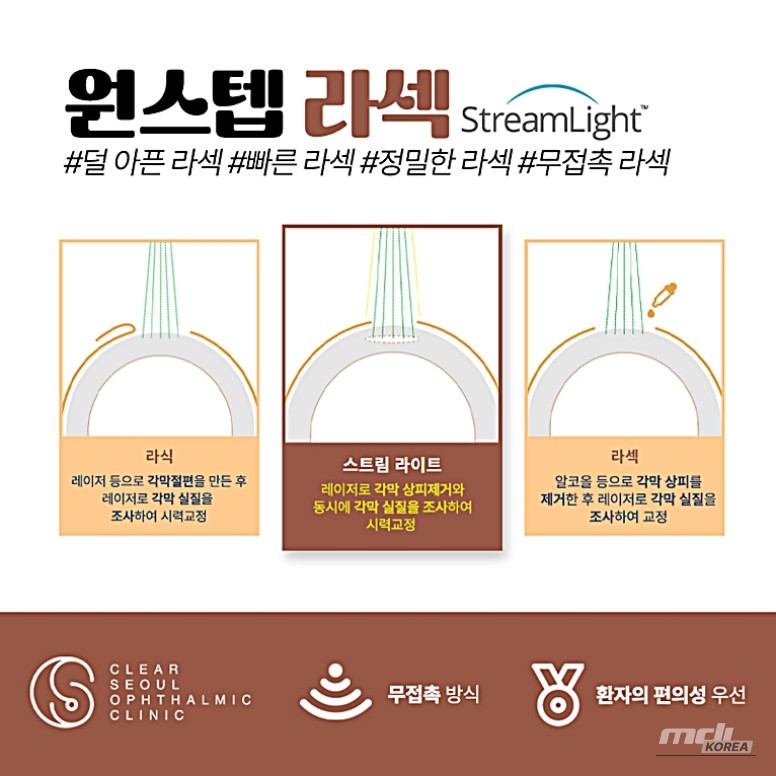
LASIK and LASEK are representative vision correction surgeries with a proven track record of safety, having been introduced in Korea over 30 years ago. LASIK involves creating a corneal flap by cutting the cornea more than 20mm, lifting the flap, using a laser to correct refractive errors, and then repositioning the flap. Because creating the flap requires a significant amount of corneal tissue to be cut, surgery may be difficult for those with thin corneas or high myopia. The eye is also vulnerable to external impact, making it difficult for athletes or those in special professions such as police officers or firefighters. However, LASIK offers minimal pain and a faster recovery, making it a good option for those with limited time or who primarily work indoors.
LASEK involves removing the corneal epithelium with alcohol or a brush to correct vision. The removed epithelium regenerates, making it strong against external impact and stable. Because only a thin layer of the epithelium is removed, surgery can be considered even for those with thin corneas or high myopia, offering a wider range of correction. However, due to the pain-sensitive nerve endings in the epithelium, there is significant pain during the recovery period, and the recovery of vision is slower.
As LASIK and LASEK have distinct advantages and disadvantages, it is important to visit an eye clinic and undergo a thorough examination to determine the most suitable surgical method. With advancements in medical technology, all-laser methods have emerged, improving upon the shortcomings of previous surgeries. Streamlight LASEK, which compensates for the disadvantages of LASEK, is particularly noteworthy.
All-Laser LASEK: Overcoming the Disadvantages of LASEK
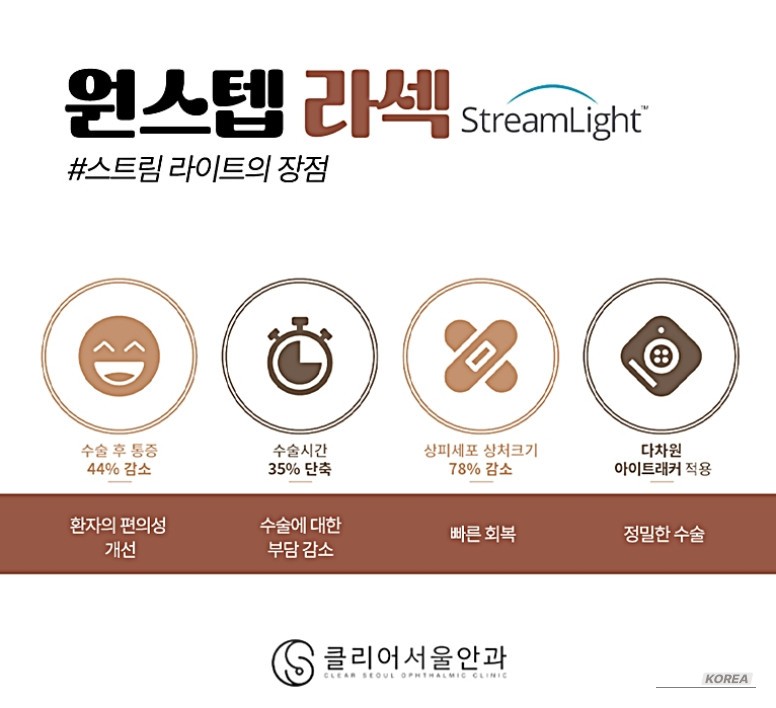
The Streamlight procedure is very similar to the existing method. However, it is performed using an all-laser method rather than using alcohol or a brush, reducing irritation and damage from surgical instruments. This can further shorten the pain period, which previously lasted more than 5 days, and allow for a quicker return to daily life with about 2-3 days of rest.
In particular, Streamlight surgery is a one-step procedure that simultaneously removes the corneal epithelium and corrects refractive errors with a laser, rather than performing these steps separately. This shortens the procedure time, reduces the amount of time the cornea is exposed, and lowers the risk of infection, dry eye, and corneal haze.
In addition, the laser is performed in a non-contact manner, reducing concerns about secondary infections. The laser ablates only the necessary areas, eliminating unnecessary incisions and reducing the wound area of the epithelial cells, further shortening the recovery period. As a result, the pain that lasted more than 5 days is reduced to one or two days, and more patients are considering surgery on weekends or holidays.
EX500 Excimer Laser
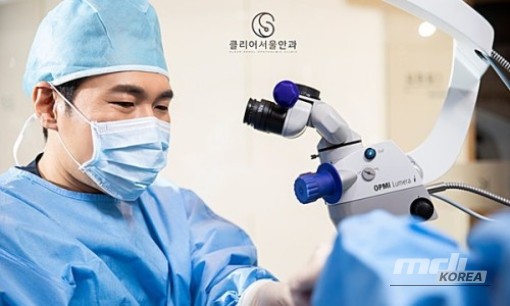
The eye clinic uses the EX500 excimer laser for all-laser LASEK surgery. The biggest feature of the excimer laser is that it has the fastest surgery time among all-laser surgeries. Even though the surgery is performed quickly, the laser flow itself is stable, allowing for smoother and more precise corneal ablation, improving the quality of vision. It also has a function that measures the thickness of the cornea in real-time during corneal ablation, allowing for the preservation of residual corneal thickness. This allows for stable results even in patients with thin corneas or high myopia and prevents corneal protrusion.
During surgery, the patient's eye may rotate due to movement. The EX500 excimer laser is equipped with an automatic eye rotation correction tracking system that ensures the laser is delivered to the center point, increasing accuracy. It is also equipped with a 6-dimensional eye tracker, rather than a general tracking device, to prevent subtle eye movements or tremors and reduce the occurrence of accidents.
Many people are curious about the cost of Streamlight surgery. The cost typically ranges from 1,000,000 to 1,500,000 KRW. However, the cost may vary depending on the equipment used, the skill of the medical staff, and the patient's eye condition. It is important to confirm the cost through a consultation.
Post-operative Care
Even though Streamlight LASEK has a fast recovery, post-operative care must be followed. In particular, excessive irritation to the eyes during the recovery period can hinder recovery or cause vision to decline again, making initial management very important. Absolute rest is required on the day of surgery, and it is best to refrain from using electronic devices. Be careful not to rub or touch your eyes, even if you feel a foreign body sensation or itchiness. Use preservative-free artificial tears to alleviate dryness. Avoid getting water in your eyes for about 3 days, and refrain from eye makeup for about 2 weeks. Light walks are possible, but high-intensity exercise can increase eye pressure, so it is best to wait about 3 weeks to a month. When going out, it is recommended to use a hat or sunglasses to reduce prolonged exposure to ultraviolet rays. There are several other precautions, so be sure to familiarize yourself with the doctor's instructions and maintain consistent care to stabilize your eyes.
Today, we have looked at Streamlight LASEK, which is performed with an all-laser method. While the correction range has generally increased and the safety of surgery has improved, it is not a surgery that can be performed on everyone. In some cases, a surgery performed before Streamlight surgery may be more appropriate. As vision correction surgery is performed on sensitive eyes, it is important to undergo a thorough examination first and find a suitable surgical method based on your eye condition to restore your vision in a stable manner.





















Source :https://blog.naver.com/whgus4231/224040683686
No comments yet.