Important Considerations Before Undergoing Vision Correction Surgery



Hello, this is Bright St. Mary Eye Clinic.
These days, many people are interested in vision correction surgery.
Since same-day examinations and surgeries are often possible, many people may want to get the surgery quickly.
However, the eyes are important organs responsible for our vision.
Therefore, today we will discuss what to be aware of for accurate examination results and better surgery outcomes.
If you are considering vision correction surgery, you will first undergo an eye examination. This examination is the most important part of vision correction surgery.
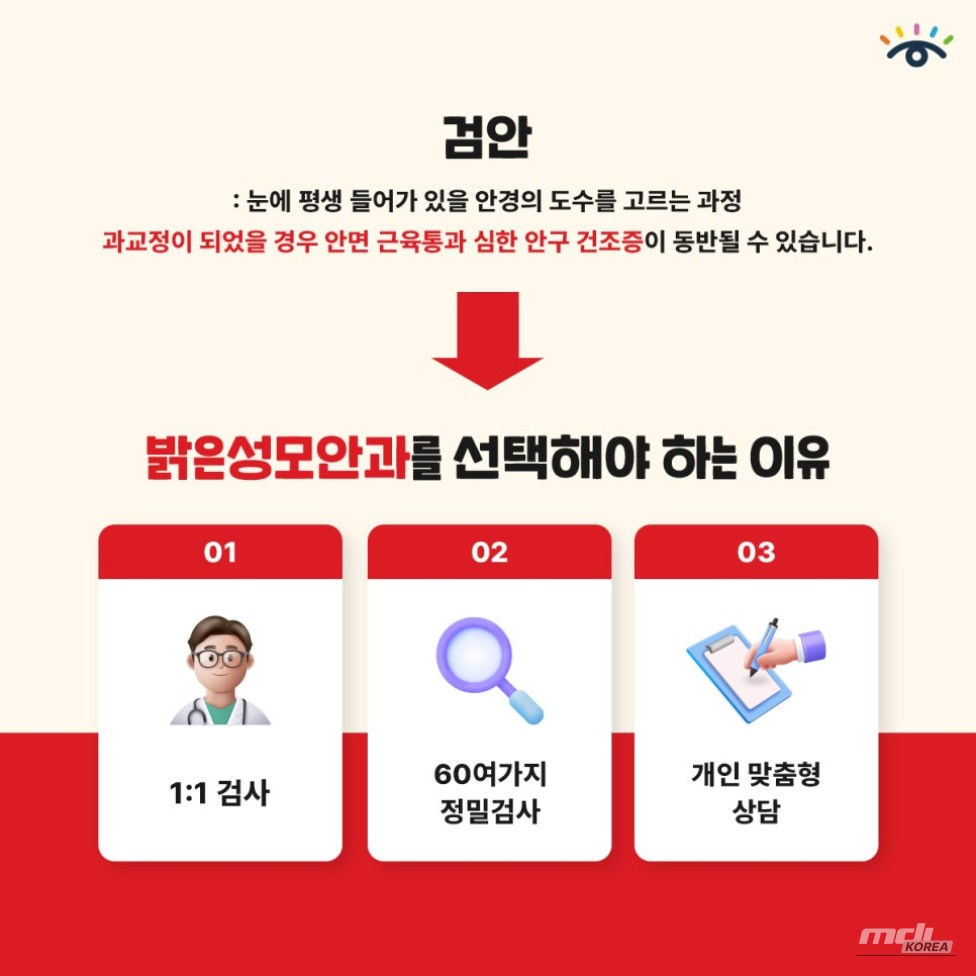
The examination is the process of choosing the refractive power of the glasses that you will essentially be wearing permanently inside your eye.
Because the eye is a living organ, the examination values may vary from time to time.
If the examination process is not done correctly and an overcorrection occurs due to errors, you may experience facial muscle pain and severe dry eye, even when looking at a normal distance.
With regular glasses and lenses, overcorrection isn't a serious problem because you can simply take them off. However, with vision correction surgery, you cannot remove the overcorrection.
Before surgery, most people are nearsighted, so when they feel eye strain, they can take off their glasses and the ciliary muscle relaxes, allowing the eye muscles to rest.
However, if overcorrection occurs, you may end up needing to wear glasses again to rest your eyes, suffering from side effects instead.
At Bright St. Mary Eye Clinic, our medical staff prioritizes the health of our patients' eyes. Therefore, we conduct a 1:1 precise examination by an optometrist before surgery.
Since accurate refractive power measurement before surgery is the most important factor, we conduct approximately 60 precise examinations to check for any abnormalities in all parts of the eye, from the cornea to the optic nerve of the retina, and to determine individual measurements, in order to prevent even a 1/100 error.
Various precise examinations are performed, including visual acuity, corneal condition, retinal thickness, and pupil size.
Through these examinations, we discuss the possibility of surgery, postoperative corrected vision, and the most suitable surgical method for your eye condition.
We have various precise examination tools and the latest surgical equipment. Our ophthalmologists also have extensive clinical experience, so you can expect stable results.
There are a few things that patients should be aware of for accurate examination and surgery.
The first is contact lenses.
If you wear contact lenses for a long time, the shape of the cornea may be compressed by the lenses. Therefore, a sufficient period is needed for the cornea to return to its original shape.
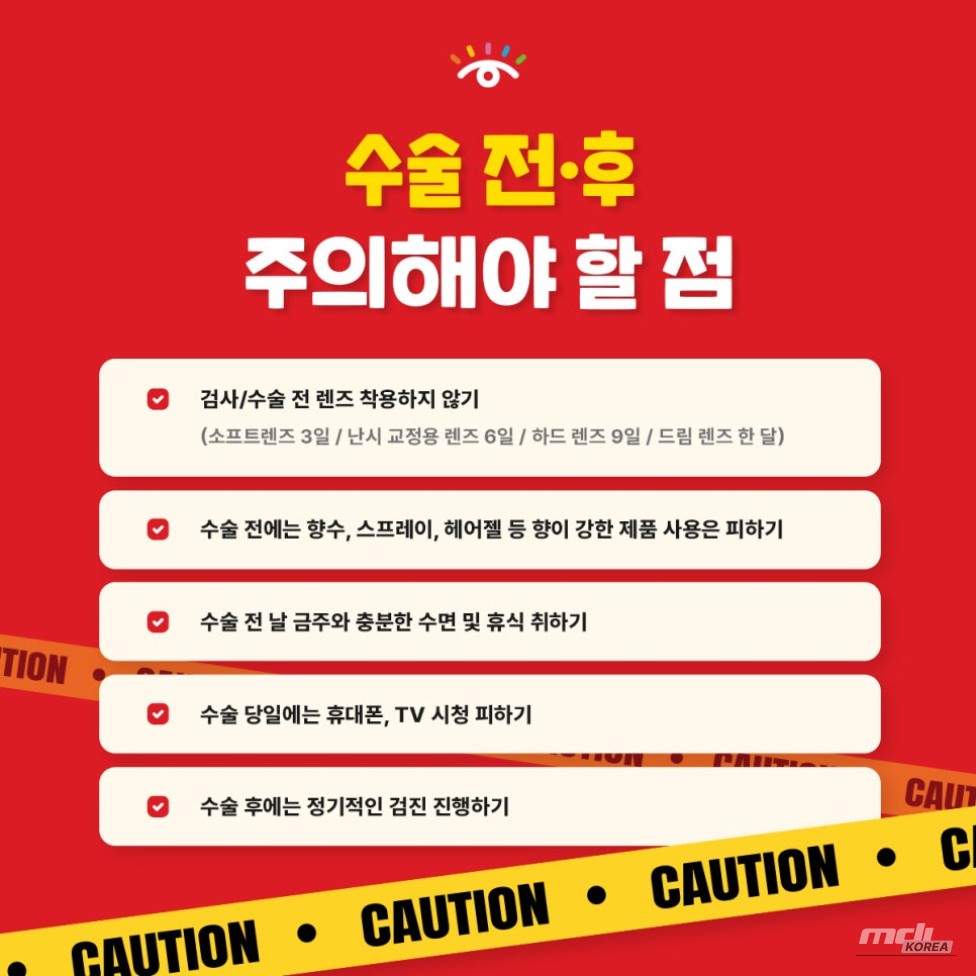
Before the examination/surgery:
Soft lenses: 3 days
Toric lenses: 6 days
Hard lenses: 9 days
Orthokeratology lenses: 1 month
It is recommended to wear glasses instead of contact lenses for the specified period before undergoing the examination and surgery.
It is important to note that since we examine the retina as well as vision, your vision may be blurry and you may experience glare, so it is safer not to drive on the day of the examination. :)
Second:
Avoid using strongly scented products such as perfume, hair spray, and hair gel before surgery.
The laser equipment used in surgery is sensitive to certain chemicals and odors, which can affect the sensors and operation.
This can negatively affect the accuracy and safety of the surgery.
Additionally, perms and dyes are also not recommended.
The chemicals used in perms and dyes contain ammonia.
Ammonia can irritate the eyes and affect the surgical equipment.
Therefore, perms and dyes are prohibited from 3 days before surgery.
Also, for the rapid recovery of sensitive eyes after surgery, it is best to avoid perms and dyes for at least one week after surgery.
Third:
Abstain from alcohol and get enough sleep and rest the day before surgery.
You should ensure your best condition on the day of surgery by getting enough rest before surgery. You should also abstain from alcohol and avoid greasy foods as much as possible the day before surgery.
Fourth:
Avoid using your phone or watching TV on the day of surgery.
On the day of surgery, your vision will generally be blurry and sensitive to light, so looking at the screen can irritate your eyes.
Lastly:
Have regular check-ups after surgery.
The recovery results of all surgeries vary depending on postoperative care.
Similarly, with vision correction surgery, if postoperative care is not properly managed, it can affect vision recovery.
Therefore, you should continue to pay attention and get regular check-ups even after surgery.
At Bright St. Mary Eye Clinic, you are automatically enrolled in a lifetime guarantee service after surgery, so you can receive regular check-ups and consultations when needed.
If vision regression occurs, we will conduct a re-examination and provide free re-correction if necessary.
We also provide management plans tailored to each patient's eye condition to help maintain stable vision.
Today, we have discussed the points to be aware of for stable vision correction surgery.
We hope that referring to the testimonials on our website will help you with your surgery plans.
We operate on an appointment basis, so please feel free to make an appointment before visiting and feel free to contact us with any questions. :)







Source :https://blog.naver.com/oklasik3/223726325899
No comments yet.