Eye Health for Office Workers: Tips and Prevention



"My eyes feel so strained."
"My eyes sting from staring at the computer all day."
"I think my vision is getting worse…"
Hello, this is Bright St. Mary's Eye Clinic.
Today, we're talking about something we all experience:
eye health for office workers.
Buried in work, swamped with meetings,
overwhelmed by the monitor.
Did you know that the most overworked part of your body in all of this is your 'eyes'?
So, why 'eyes' specifically?
The modern office worker's day
starts and ends in front of a monitor.
From turning on the computer as soon as you get to work,
to reviewing data and exchanging emails throughout the workday, your eyes don't get a break.
After work,
you watch YouTube or browse social media on your smartphone, further straining your eyes.
Studies show that people spend an average of over 10 hours a day using digital devices.
With such repetitive habits,
it's no wonder that our eye health is at risk.
Especially these days, with video conferences and digital communication being the norm,
more and more office workers are complaining about eye problems.
Why is eye health deteriorating among office workers?
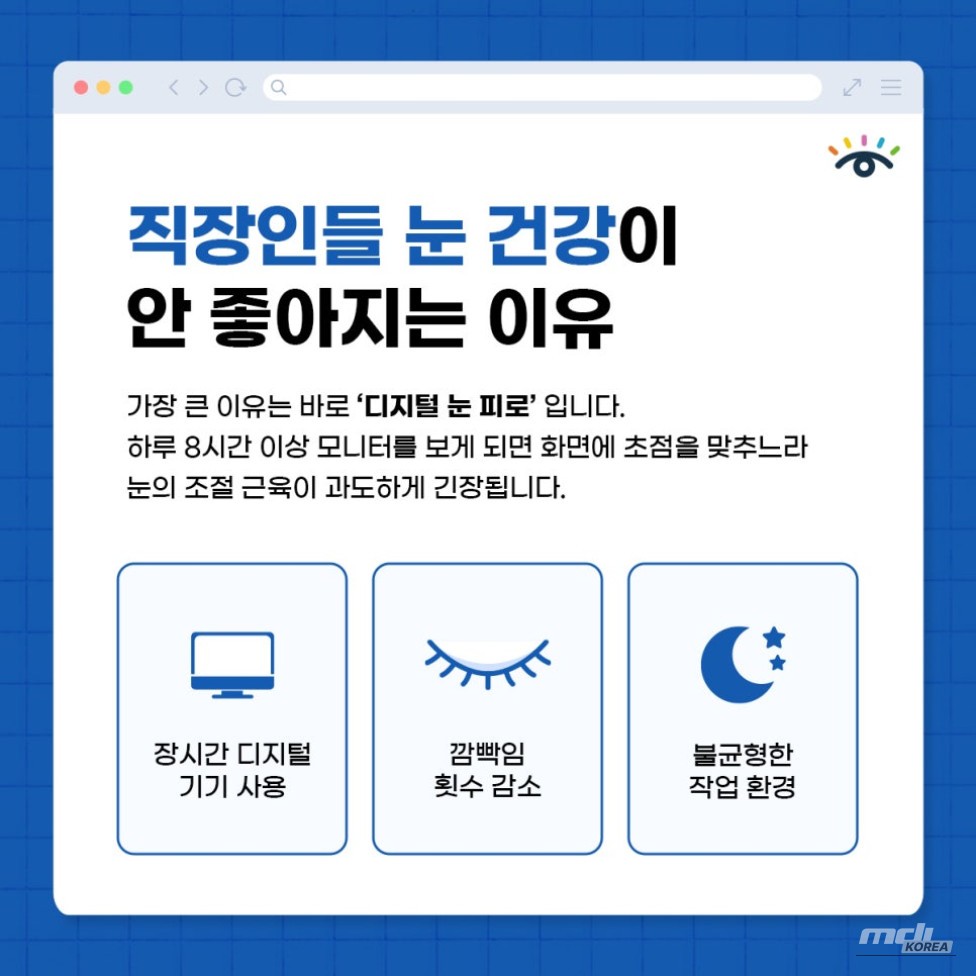
1. Prolonged Use of Digital Devices
The biggest reason is 'digital eye strain'.
Spending more than 8 hours a day looking at a monitor
causes the eye muscles to constantly focus on the screen,
leading to excessive tension and, as a result, eye fatigue, dryness, and in severe cases,
headaches and shoulder stiffness.
2. Reduced Blinking Frequency
When focusing intently on a monitor, people
unconsciously blink less.
Normally,
we blink about 15-20 times per minute,
but when looking at a screen, this decreases to about 5-7 times per minute.
This results in insufficient tear production,
causing dry eyes
and worsening dry eye syndrome.
3. Unbalanced Work Environment
Factors such as lighting that is too bright or too dim,
an improperly positioned monitor,
or a screen that is too close to the eyes
can also contribute to eye strain.
Poor ventilation and
air conditioning or heaters blowing directly at the eyes
can also cause dryness.
What if the symptoms worsen?
You might initially dismiss it as simple fatigue, but
neglecting eye health problems can lead to
chronic dry eye syndrome, vision loss,
and in severe cases, even corneal damage.
Special attention is needed if you often work overtime,
consume a lot of coffee or energy drinks, or
lack sleep.
How to protect your eye health!
1. Practice the 20-20-20 Rule
This is a simple eye exercise recommended by
the American Academy of Ophthalmology.
Every 20 minutes, look at something 20 feet (about 6 meters) away
for 20 seconds.
This method helps relieve eye muscle tension
and reduce fatigue.
2. Maintain Adequate Humidity
If the air in the office is too dry,
your eyes will dry out easily.
Place a small humidifier on your desk or
grow plants to maintain humidity in the air.
3. Use Artificial Tears
If your eyes are too dry,
using eye drops is a good option.
However, it is safer for your eyes to use
products that do not contain preservatives.
Using them only about 3-4 times a day
can help prevent dry eye syndrome.
4. Blue Light Blocking Glasses
Blue light causes eye fatigue and
affects sleep quality.
These days, there are many glasses or monitor filters
with lenses that block blue light,
so it's a good idea to try them.
Especially if you often use your smartphone at night,
it is good to use a filter app.
5. Healthy Eating Habits
Eat plenty of foods
rich in omega-3, vitamin A, and lutein,
which are good for eye health.
Fish, carrots, spinach, and blueberries
are typical eye health foods.
6. Regular Eye Exams
Rather than only going to the hospital when your eyes are uncomfortable,
even if your vision hasn't worsened,
it is good to get regular checkups
at least once a year.
From your late 30s, early diagnosis can prevent diseases
like macular degeneration or glaucoma.
Don't ignore the small signals your eyes send.
Habits protect eye health.
Feeling that your eyes are stiff and dry
may be simple fatigue, but
it may also be a sign
that appears before health problems occur.
The more time you spend sitting in front of a computer,
the better you should take care of your eyes!
One small habit can be a big change
that protects eye health.
Once eye health deteriorates, it is not easy to recover.
But fortunately, most digital eye strain
can be prevented with the right habits.
By resting your eyes for even just a few minutes each day,
improving your environment, and taking regular care,
you can maintain healthier vision
for a long time.
To all of you who are busy working today,
take a moment to look away from the monitor
and enjoy the view of the sky outside the window.
That short moment can be a great rest for your eyes
and for you.
Close your eyes, take a deep breath, and give your eyes a rest.
Healthy eyes are directly related to your quality of life.
Why not start a habit for eye health
from this moment on?















Source :https://blog.naver.com/oklasik3/223853536719
No comments yet.