Does Dark Mode Really Help Your Eye Health?



Hello, this is Bright St. Mary's Eye Clinic.
Many of you are spending more and more time looking at your smartphones or computer screens these days, right?
When you use digital devices frequently, you naturally feel eye strain.
Therefore, various methods to protect your eye health are also gaining attention.
One of them is Dark Mode.
Today, we're going to explore how much Dark Mode actually helps your eye health and in what situations it can be used effectively.
As smartphones and computers have become deeply integrated into our daily lives, the time we spend looking at digital device screens has increased.
This environmental change has caused eye fatigue and discomfort for many, and as a result, digital eye strain is emerging as a major health concern.
In this situation, Dark Mode is gaining attention as a solution to reduce the burden on the eyes.
However, there is ongoing discussion about whether Dark Mode really has a positive impact on eye health or whether it is simply a feature to improve user experience.
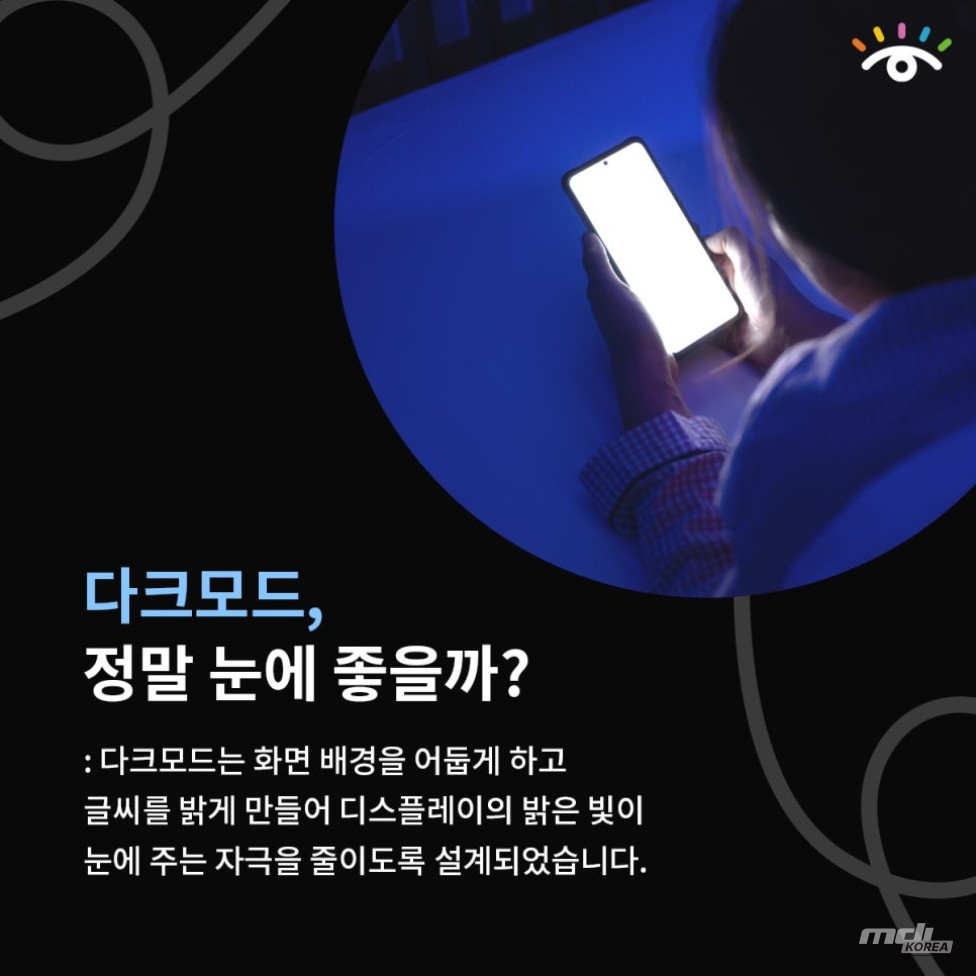
Dark Mode is designed to darken the screen background and brighten the text to reduce the stimulation of bright light from the display on the eyes.
While traditional Light Mode consists of a white background and black text, Dark Mode uses a black background and white or bright-colored text.
This change primarily reduces glare and provides a more comfortable visual experience when using digital devices at night or in dark environments.
However, it is necessary to analyze from various perspectives whether this also has beneficial effects on eye health.
Positive Effects of Dark Mode on Eye Health
The grounds for arguing that Dark Mode has a positive effect on eye health mainly come from the following reasons:
1. Reduced Glare
Bright screens can directly stimulate the eyes, which can worsen fatigue, especially in low-light environments.
Using Dark Mode allows you to check content while reducing screen brightness, so you can expect the effect of reducing glare.
2. Reduced Blue Light
Blue light emitted from digital displays can cause eye fatigue when exposed for a long time, and in particular, it can suppress the secretion of melatonin, a sleep hormone, and interfere with a good night's sleep.
Dark Mode can help mitigate these side effects by reducing blue light.
3. Advantageous for Nighttime Use
In dark environments, the bright background of Light Mode can create a large contrast with the surroundings, putting more strain on the eyes.
On the other hand, Dark Mode provides a relatively comfortable visual experience because the dark background harmonizes well with the surrounding environment.
Limitations and Precautions of Dark Mode
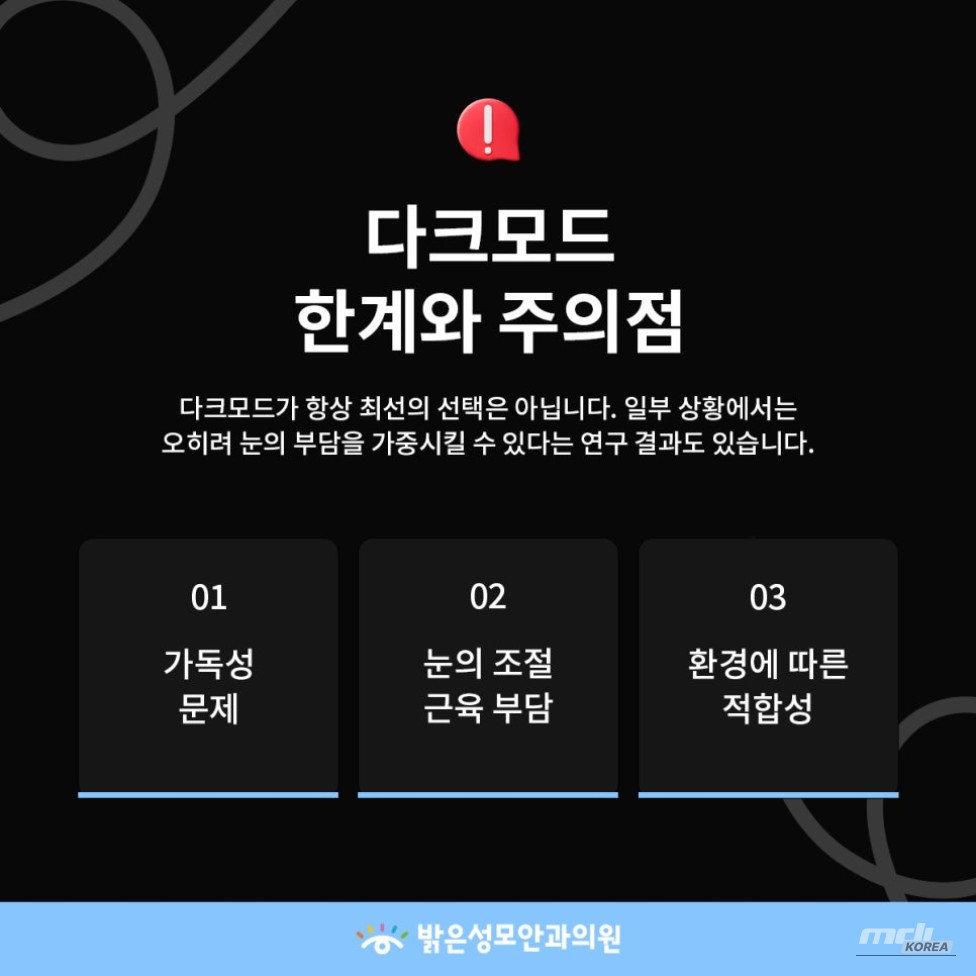
Dark Mode is not always the best choice. Some studies have shown that it can actually increase the burden on the eyes in certain situations.
1. Readability Issues
Dark Mode can require more concentration to read text due to the strong contrast between the dark background and bright text.
Readability may be lower compared to Light Mode, especially when reading small text or complex text.
In bright environments such as daytime, Dark Mode may cause more eye strain.
2. Burden on Eye Adjustment Muscles
In Dark Mode, the edges of the text may not be clear, so the eyes may have to make more focusing efforts.
This may increase eye fatigue with prolonged use.
3. Suitability Depending on the Environment
Dark Mode is advantageous in dark environments, but in bright environments, it can make it difficult to see the screen content.
Therefore, Light Mode may be more suitable during the day or under bright lighting.
How to Protect Eye Health When Using Dark Mode
To use Dark Mode effectively, it is recommended to refer to the following methods:
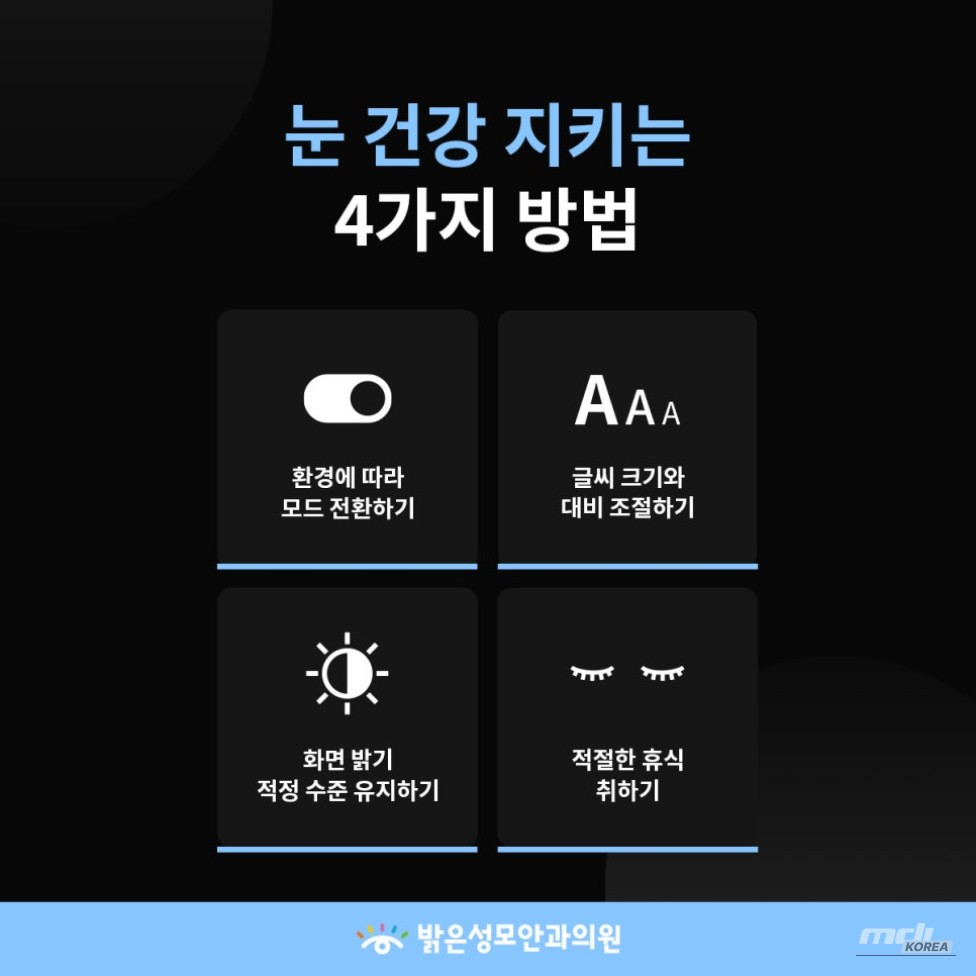
1. Mode Switching According to the Environment
Ideally, use Dark Mode at night or in dark environments with low brightness, and use Light Mode in bright environments.
2. Adjust Font Size and Contrast
When using Dark Mode, increasing the font size and appropriately adjusting the contrast between the background and text can improve readability and reduce eye strain.
3. Maintain Appropriate Screen Brightness
If the screen brightness is too low, the eyes have to work harder, so you should maintain an appropriate brightness even in Dark Mode.
4. Take Adequate Rest
If you use digital devices for a long time, Dark Mode alone cannot completely relieve eye fatigue.
It is important to rest your eyes by practicing the '20-20-20 rule', which involves looking at a spot 6 meters away for 20 seconds every 20 minutes.
Will Dark Mode Help Eye Health?
Dark Mode can be effective in reducing eye strain and improving the digital device user experience in certain situations.
It is especially useful for reducing glare in dark environments and reducing blue light exposure.
However, as mentioned earlier, Light Mode may be more suitable in bright environments such as daytime, and Dark Mode itself cannot completely solve eye fatigue caused by digital devices.
Therefore, it is most effective to use a combination of Dark Mode and Light Mode appropriately according to the environment.
Also, it is important to reduce digital screen usage time and check your eye health regularly.
Dark Mode is just one way to manage eye health, and it is important to remember that it is not a fundamental solution.
Eye health starts with small practices. Maintain healthy eyes in the digital age by using the appropriate mode for your environment and practicing good screen usage habits.
If you have any questions, please feel free to contact us for a consultation.










Source :https://blog.naver.com/oklasik3/223867901472
No comments yet.