Crucial Questions to Ask When Choosing Cataract Lenses



Choosing a cataract lens is a once-in-a-lifetime decision.
To help you make the right choice,
I'll share three essential questions you MUST ask at the clinic.
I'm an ophthalmologist with 16 years of experience,
and I've performed over 20,000 cataract surgeries.
I've even done as many as 51 surgeries in a single day.
Even with my extensive experience,
I always have in-depth conversations with my patients when selecting a cataract surgery lens.
This is because the chosen lens will determine how they see the world for the rest of their lives.
Therefore, I've identified three key questions that I always ask my patients.
Other clinics may not ask these questions proactively,
so it's important to bring them up yourself.
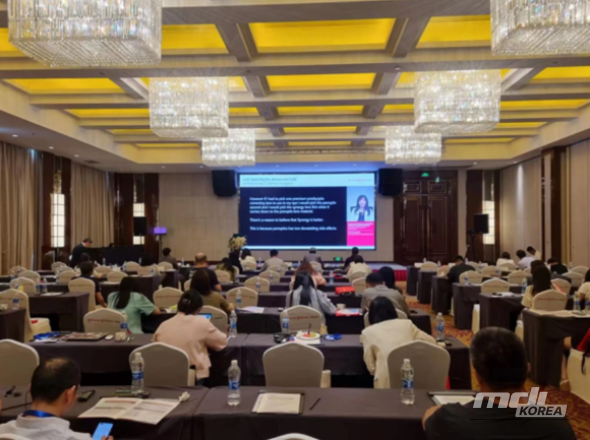
(I even lectured on lens selection to over 100 ophthalmologists at China's largest ophthalmology conference!)
First: Occupation
Whether you're in an office job, sales, agriculture, driving, etc.,
it's crucial to discuss your 'working distance' with your doctor.
For example, many doctors come to our clinic.
Depending on their specialty, their required working distance varies.
Plastic surgeons, obstetricians, and dermatologists need excellent close-up vision.
General practitioners, neurologists, and pediatricians need good intermediate vision.
Radiologists, gastroenterologists, and cardiologists need good intermediate and mid-range vision.
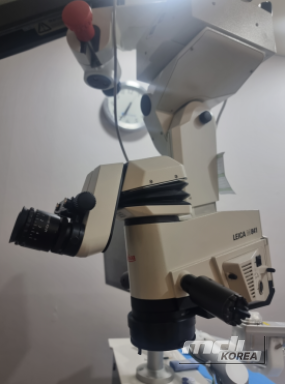
Neurosurgeons, pathologists, and laboratory medicine specialists need to be able to use microscopes, requiring a different lens classification.
Therefore, it's not enough to simply consider your job title.
You MUST inform your doctor about the specific working distances required by your job.
Without this information, choosing a lens based solely on cost-effectiveness
or blindly opting for the most expensive option
can lead to lifelong discomfort for the next 40-50 years.
Recently, a top instructor from Daechi-dong came to our Healing Eye Clinic.
This teacher needed to see books up close (40-50cm),
the whiteboard (70-80cm),
and even the students far away (1.5m+).
This teacher consulted with three different hospitals.
One recommended a monofocal lens for nearsightedness,
another recommended Eyhance,
and the third recommended PureSee.
However, using Eyhance or PureSee in both eyes
would make it very difficult for the teacher to read books while teaching.
They need to freely switch their focus between books, the whiteboard, and the students.
A lens that doesn't provide clear close-up vision could make reading books impossible.
This would force them to constantly switch between glasses during class, even after surgery.
We always have cataract surgery lenses ready for immediate surgery.
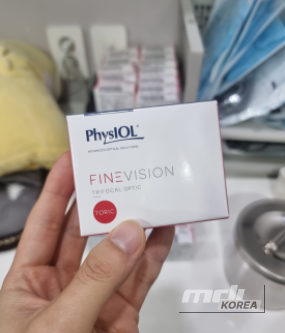
For this teacher, the best combination is 'PureSee + a diffractive lens (e.g., Synergy, PanOptix, Ziemetric, etc.)'.
PureSee strongly focuses on mid-range vision,
while the diffractive lens enhances close-up vision.
(Using diffractive lenses in both eyes can compromise mid-range vision.)
The teacher is currently very satisfied and reports no issues with teaching.
Therefore, it's crucial to tell your doctor about your occupation
and discuss the details before choosing a lens.
(Johnson & Johnson, a US cataract lens company, specifically visited our Healing Eye Clinic!)
Second: 'What activities do you enjoy?'
You MUST tell your doctor this.
(This is similar to occupation.)
I always ask every patient who comes in for cataract surgery,
'What are your hobbies?'
Most elderly patients over 70 say,
'What hobbies? I can't see well, so I just stay home and do nothing.'
But hobbies are about...
what you enjoyed doing when your vision was good,
and what you want to do when your vision is restored.
Golf,
fishing,
billiards,
reading,
These are all joys in life...
Many people start doing them again once their vision improves.
However, people often don't consider this when choosing a lens,
and later regret things like,
'I can't see the golf ball clearly in the distance...' (Golf)
'I still need reading glasses to read books after surgery...'
Religion can also be an important factor here.
Churches and cathedrals can be dimly lit, and the Bible has small print.
In temples, good vision is needed to distinguish Chinese characters and read the Heart Sutra.
There are many points to consider.
So, before visiting the ophthalmologist, ask yourself,
'What would I enjoy doing if my vision was good?'
This will be very helpful.
Third: 'Can you correct my astigmatism?'
You MUST ask this.
In my experience,
about 8 out of 10 people have astigmatism.
If astigmatism remains after surgery, you may see double or triple vision,
so it's essential to correct it.
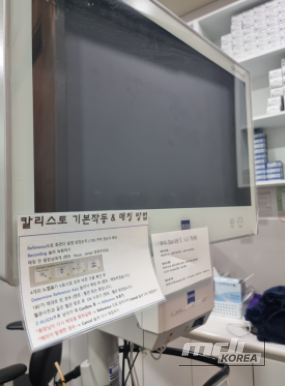
Correcting astigmatism requires expensive equipment (around 250 million won), such as the Callisto eye system.
According to the representative in charge of the astigmatism machine,
only about 85 units have been sold in Korea.
Out of thousands of ophthalmology clinics in Korea,
only 85 have this machine, and many clinics don't even bother correcting astigmatism.
Doctors don't often mention it on blogs or YouTube...
so patients don't realize the importance of astigmatism correction.
Even if cataract removal improves vision,
seeing double or triple for the rest of your life
can be frustrating and uncomfortable.
Therefore, when you visit the ophthalmologist, be sure to ask,
'Do you correct astigmatism?'
So, today, I've shared three essential questions to ask in the clinic
to help you choose the right lens for your once-in-a-lifetime surgery:
1. Occupation
(Explain your working distances in detail.)
2. Hobbies
(What you want to do, even if you're not doing it now.)
3. Astigmatism
(8 out of 10 people have it!)
If you've read this and would like to consult with me,
please read at least 2-3 more blog posts before contacting me.
Just as clapping requires two hands,
I can provide the best consultation
if you trust me and visit my clinic.
Please read the following article, which I wrote myself,
before making a reservation. ^_^
<Must-Read Before Visiting Healing Eye Clinic>
<Reservations & Directions>
This post is for informational purposes only
and complies with Article 56, Paragraph 1 of the Medical Law.
It was written directly by me.









Source :https://blog.naver.com/wpsjtltmals7/223986040961
No comments yet.