Aging and Your Eyes: Understanding Presbyopia and Cataracts


Hello, this is Bright St. Mary Eye Clinic.
As we age, our cells' ability to regenerate decreases, leading to aging that negatively affects our entire body.
This also adversely affects the tissues of the eye. The eye is a delicate organ where various structures interact.
Therefore, it is significantly affected by aging. When eye function declines,
vision deteriorates, and the risk of developing various eye diseases increases.
Modern people spend a lot of time using electronic devices,
so degenerative changes occur rapidly, and the age of onset of eye diseases is gradually decreasing.
Eye tissues are organs that do not regenerate once damaged,
so it is advisable to address problems promptly in the early stages.
Those in their 40s or older, or with a family history, are more likely to develop various eye diseases,
so it is good to have regular eye exams.
Today, we will provide detailed information on the topic of 'presbyopia and cataracts' among various eye diseases.
Presbyopia and cataracts occur around the same time,
making them difficult to distinguish.
Unlike typical presbyopia, cataracts can lead to blindness,
so if you experience any abnormal symptoms, you should visit a medical institution as soon as possible
and receive appropriate treatment.
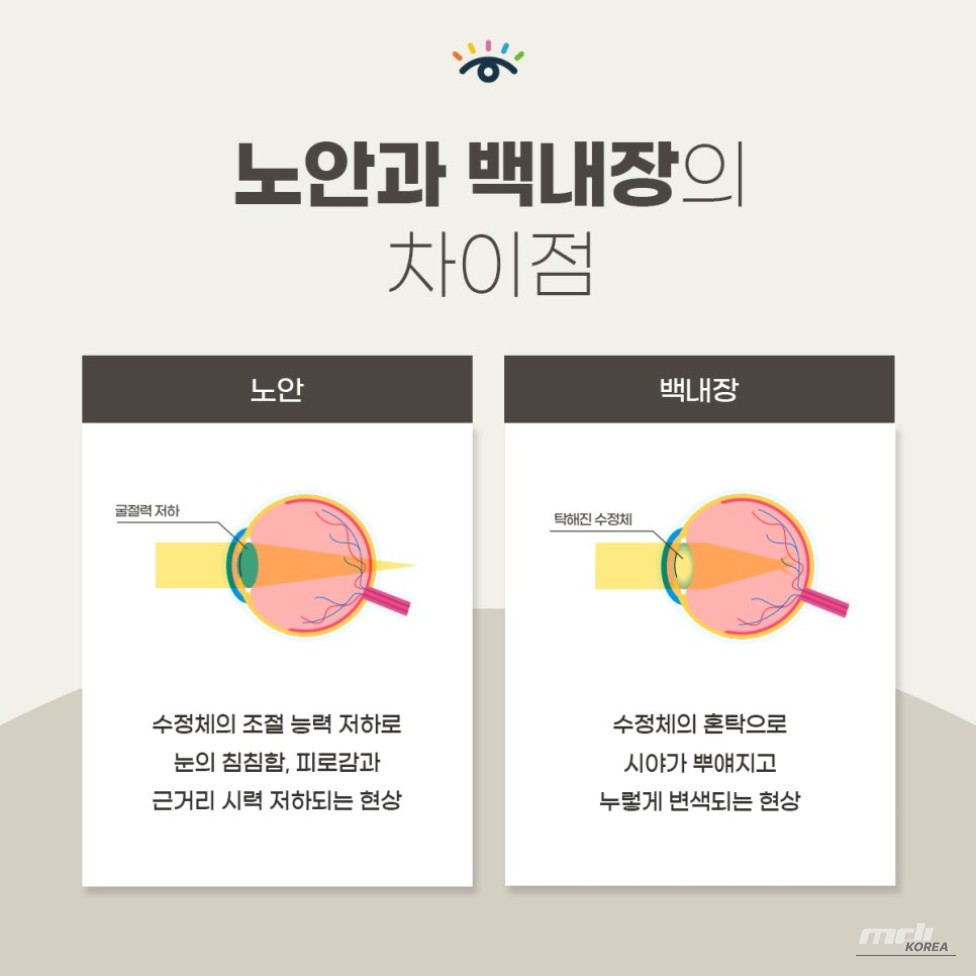
"The Differences Between Presbyopia and Cataracts"
Our eyes have a structure in which various organs such as the cornea, iris, lens, and retina are organically connected,
and each performs different functions.
Among them, the lens is a structure that acts like the lens of a camera,
receiving energy and focusing.
As we age, the muscles of the lens weaken,
resulting in a decreased ability to adjust, which is the cause of presbyopia.
As focusing becomes difficult,
objects that are close become difficult to see,
and to improve this, you need to wear reading glasses.
If letters in books, newspapers, or close objects appear blurry,
or if your eyes feel tired even after resting,
you should suspect presbyopia.
In addition, overall vision deterioration,
blurred and dry eyes often accompany it,
and symptoms are relieved by wearing reading glasses.
On the other hand, cataracts are a disease in which the lens becomes cloudy,
and because the lesion damages the transparency of the tissue,
the field of vision becomes blurry and stuffy.
Both presbyopia and cataracts are caused by abnormalities in the lens,
but cataracts are a disease in which cloudiness is more of a problem than functional decline.
Therefore, symptoms do not improve even when wearing reading glasses,
and as the disease progresses,
various visual impairment symptoms appear, causing significant disruption to daily life.
"How to Treat Presbyopia and Cataracts?"
When presbyopia and cataracts develop, the lens becomes cloudy,
preventing light from passing through properly, not only blurring the field of vision
but also making it difficult to distinguish colors.
In addition, vision is easier to secure at night than during the day,
and as it worsens, it can develop into a fatal eye disease called glaucoma.
The main cause is degenerative changes due to aging,
but it can also be caused by trauma, drug side effects, or metabolic diseases such as diabetes.
If you start managing it in the early stages,
drug therapy is applied, which is a conservative therapy
that is performed to prevent the symptoms from worsening.
Since the disease is caused by cloudiness in the lens,
treatment is performed to slow the progression of the disease,
and surgery is performed when discomfort increases.
Cataract surgery is a solution that removes the damaged lens
and inserts an artificial lens,
which has the advantage of improving presbyopia symptoms as well.
The timing of surgery is determined according to the patient's condition,
and if you come too late, treatment may be difficult,
so it is good to get early management.
"Artificial Lens Insertion Using Pure See Lens"
Artificial lenses used in presbyopia and cataract surgery
have different advantages and disadvantages depending on the manufacturing company,
and the device is selected according to the eye condition and the patient's needs.
The devices used include monofocal, multifocal,
and astigmatism-correcting lenses,
and monofocal lenses are tools that can only secure one field of vision, either near or far.
Therefore, you need to wear additional reading glasses after the procedure,
and to reduce this inconvenience,
it is better to choose other solutions such as multifocal lenses
and undergo surgery.
Multifocal lenses have the advantage of securing near, far,
and intermediate distance vision,
but side effects such as light scattering and decreased night vision may occur.
To compensate for these shortcomings,
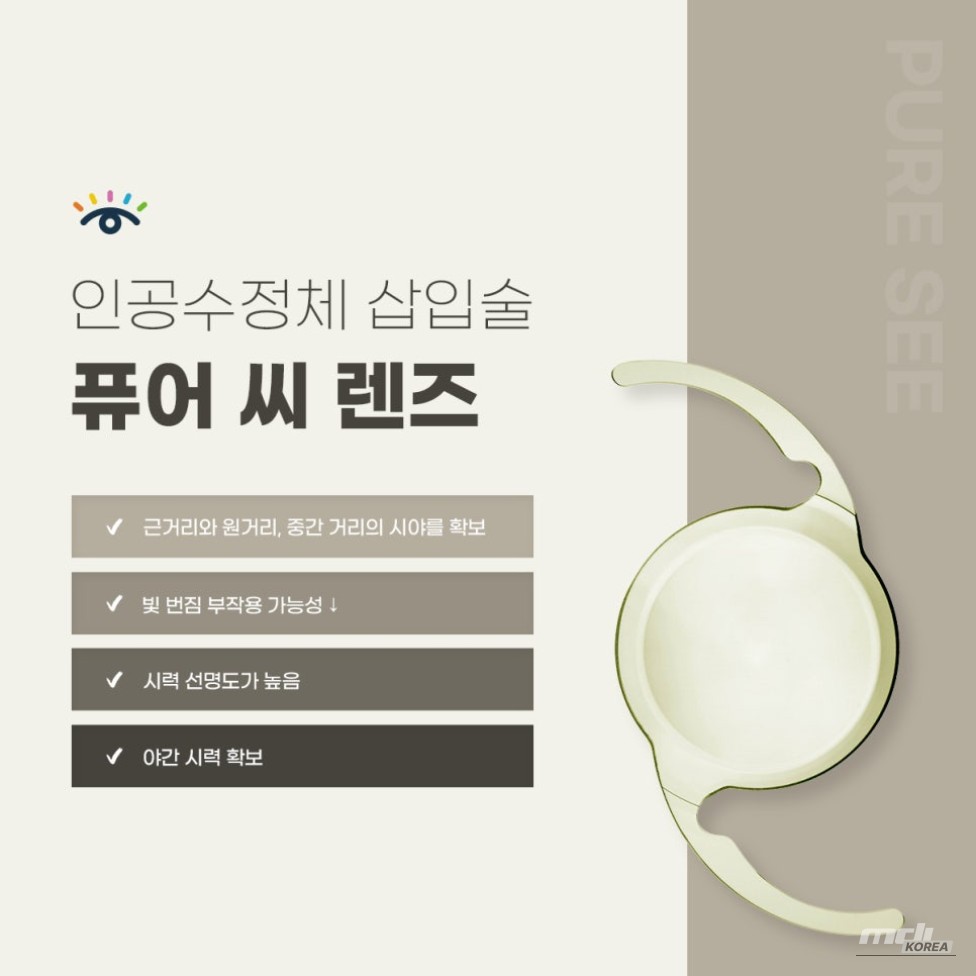
our hospital applies Pure See lenses,
which have high visual clarity and a low probability of side effects,
to perform presbyopia and cataract surgery.
It can clearly secure near, far, and intermediate distance vision,
and it is easy to secure night vision,
so many people are choosing this solution.
"A Place Where You Can Trust and Receive Treatment"
In order to increase treatment satisfaction,
our hospital has a variety of artificial lenses
and introduces high-performance medical equipment
to increase the accuracy of diagnosis.
Since the procedure is performed using an all-laser surgery method,
damage is reduced and the recovery period is also shortened,
so patient satisfaction is very high.
Based on our extensive clinical experience
with various eye diseases as well as presbyopia and cataracts,
we provide systematic examinations
so you can trust and receive care.
Cataracts can cause serious visual impairment if left untreated for a long time,
so if you have any abnormal symptoms, please visit us as soon as possible
to have a thorough examination.









Source :https://blog.naver.com/oklasik3/223774715935
No comments yet.